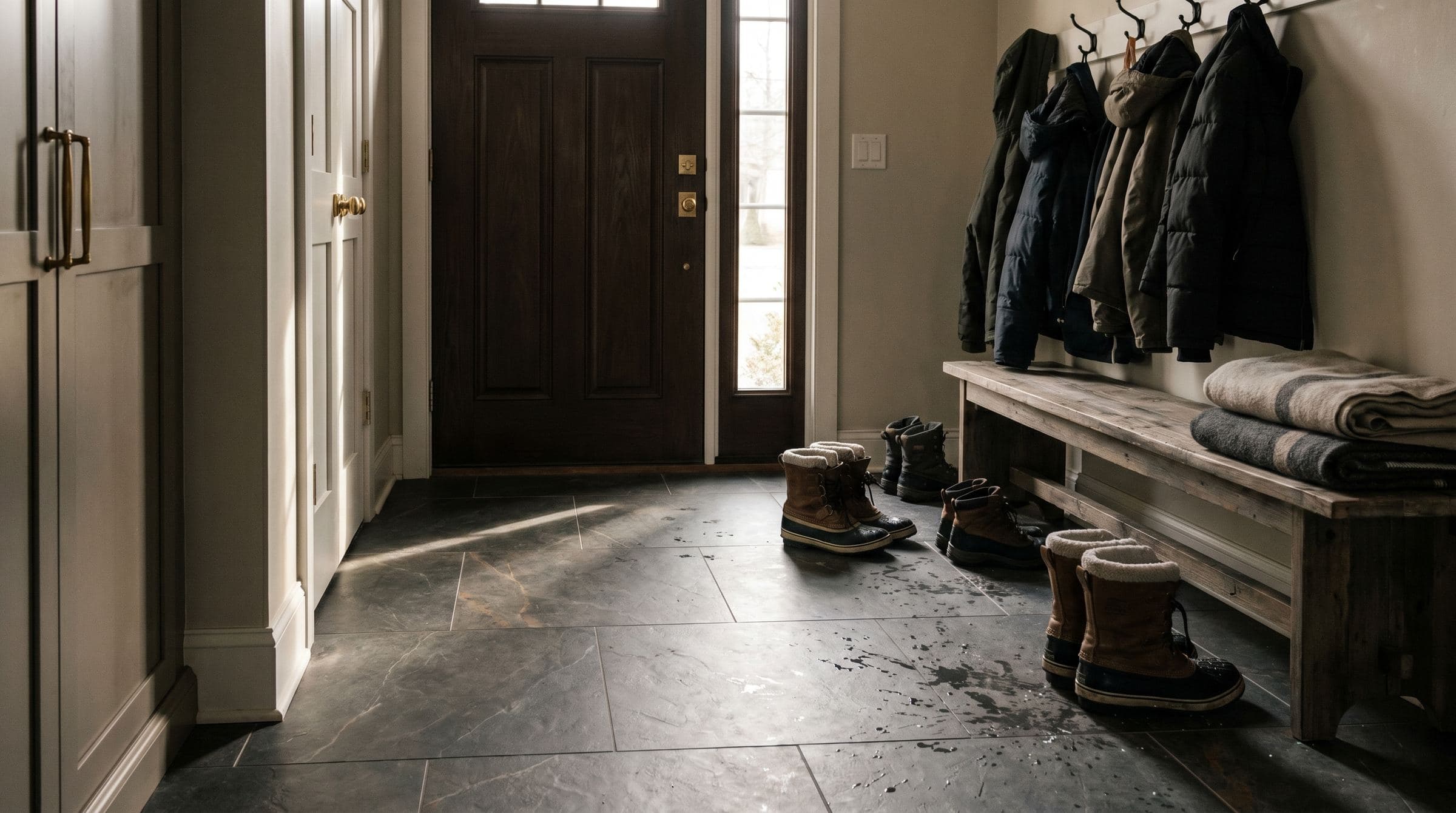
Nobody thinks about their entryway floor until it looks terrible. And in New Jersey, that happens fast. Between November and April, your mudroom or front entryway absorbs rock salt, sand, snowmelt, mud, and whatever else comes in on boots and shoes. The floor you chose for that space either handles it or it doesn't. There's no middle ground.
We've ripped out entryway tile in homes across Monmouth and Ocean County that was installed fewer than five years ago. Cracked marble. Stained limestone. Chipped ceramic with a glaze so thin the body underneath turned brown from moisture. Every one of those homeowners thought they picked a durable tile. They picked a pretty tile that wasn't rated for the conditions.
What Makes Entryway Tile Different From Bathroom or Kitchen Tile?
Entryway and mudroom tile needs to survive three things that most interior floors never deal with: abrasion from grit, thermal shock from cold-to-warm transitions, and standing moisture from wet boots and dripping coats. A tile that works beautifully in a master bathroom will fail in a mudroom because the demands are completely different.
The key specs to look for:
- PEI rating of 4 or 5 (porcelain enamel institute abrasion resistance). PEI 3 is fine for bathrooms. Entryways need 4 minimum.
- Water absorption under 0.5%. This classifies as "impervious" tile. Anything higher absorbs moisture, which causes staining and freeze-thaw damage if the entryway isn't climate-controlled.
- Slip resistance (DCOF 0.42+). Wet entryway floors are lawsuit-level slippery with polished tile. You need texture or a matte finish.
- Through-body color. If the tile chips, through-body porcelain shows the same color underneath. Glazed ceramic shows a white or red clay body.
Which Tile Materials Hold Up Best in NJ Entryways?
Full-body porcelain is the best choice for most mudrooms and entryways in New Jersey. It checks every box: low absorption, high abrasion resistance, available in large formats, and it doesn't show chips. Here's how the common options compare:
| Material | Durability | Slip Resistance | Maintenance | Cost per sq ft (installed) |
|---|---|---|---|---|
| Full-body Porcelain | Excellent | Excellent (textured) | Very low | $12 - $22 |
| Glazed Porcelain | Good | Good (matte finish) | Low | $10 - $18 |
| Natural Slate | Good | Excellent (natural texture) | Medium (seal yearly) | $14 - $28 |
| Glazed Ceramic | Fair | Varies | Low until chips | $8 - $14 |
| Polished Marble | Poor for entryways | Poor (slippery wet) | High | $20 - $45 |
We install a lot of wood-look porcelain planks in mudrooms throughout Brick, Toms River, and the Freehold area. They give the warmth of a hardwood entry without any of the water damage risk. A 9x36 or 12x48 plank in a matte, textured finish hides dirt between cleanings and handles rock salt without etching.
Why Is Marble a Bad Choice for Entryways?
Marble is calcium carbonate. Rock salt is sodium chloride. When salt slurry sits on marble, it etches the surface, leaving dull white spots that no amount of polishing fully removes. We've seen Carrara marble entryways in Long Branch and Rumson that looked cloudy and damaged after a single winter. The homeowners spent $40+ per square foot on a floor that couldn't survive its own environment.
If you want a stone look in your entryway, porcelain tiles that mimic marble or travertine give you the aesthetic without the vulnerability. The manufacturing has gotten good enough that you can't tell the difference from standing height. You can tell the difference after five winters.
What Size Tile Works Best for Mudrooms?
Larger tiles mean fewer grout lines, and fewer grout lines mean less maintenance. Grout absorbs dirt and moisture faster than tile does. In a high-traffic mudroom, wide grout lines between small tiles become the dirtiest part of the floor within months.
Our recommendations by room size:
- Under 40 sq ft (small foyer): 12x24 porcelain, staggered brick pattern. Large enough to minimize grout, small enough to cut without waste.
- 40-80 sq ft (standard mudroom): 24x24 or 12x48 planks. The larger format makes the space feel bigger and cuts grout lines in half.
- Over 80 sq ft (large mudroom/laundry combo): 24x48 or 32x32. Fewer seams, cleaner look, faster install.
For grout, we use epoxy grout in entryways, not standard cement grout. Epoxy is non-porous, stain-proof, and doesn't need sealing. It costs more upfront but saves every dollar back in maintenance over the first two years.
How Do You Prep a Mudroom Floor for Tile?
Substrate prep is where entryway tile jobs succeed or fail. Most mudrooms in Monmouth and Ocean County homes have plywood subfloors, and plywood moves with humidity and temperature changes. If you set tile directly on plywood, the movement will crack grout lines within one season.
- Check subfloor deflection. The L/360 rule: the floor should not flex more than 1 inch per 360 inches of span. If it bounces when you walk, it needs reinforcement before any tile goes down.
- Install an uncoupling membrane (Schluter Ditra or equivalent). This decouples the tile from subfloor movement so expansion and contraction don't transfer into the tile layer.
- Waterproof if the room has exterior doors. Any mudroom with a door to the outside needs a waterproofing membrane, especially in NJ where snow and rain blow in.
- Slope to a drain if possible. In dedicated mudrooms, a subtle slope (1/4 inch per foot) toward a floor drain means puddles from wet gear drain instead of sitting.
Skipping the membrane to save $2 per square foot is the single most common mistake we see in DIY and low-bid contractor entryway installs. The membrane costs about $400-600 on a typical mudroom floor. Ripping out cracked tile and reinstalling costs $3,000+.
What Does a Mudroom Tile Job Cost in NJ?
For a properly installed mudroom floor in Monmouth or Ocean County, including membrane, epoxy grout, and quality porcelain, expect:
- Small foyer (30-50 sq ft): $1,200 - $2,200 installed
- Standard mudroom (50-80 sq ft): $2,000 - $3,800 installed
- Large mudroom with bench/storage area (80-120 sq ft): $3,200 - $5,500 installed
That includes tile, materials, labor, and proper prep. It does not include demolition of existing flooring (add $3-6 per sq ft) or any carpentry for built-in benches or cubbies.
The homeowners who spend the least over 10 years are the ones who invest in the right materials and prep on day one. A $2,500 mudroom floor that lasts 20+ years costs less than a $1,200 install you're ripping out in year four.
Planning an entryway or mudroom project this spring? Get a free estimate and we'll walk through the material options that make sense for your home, your traffic, and your budget.