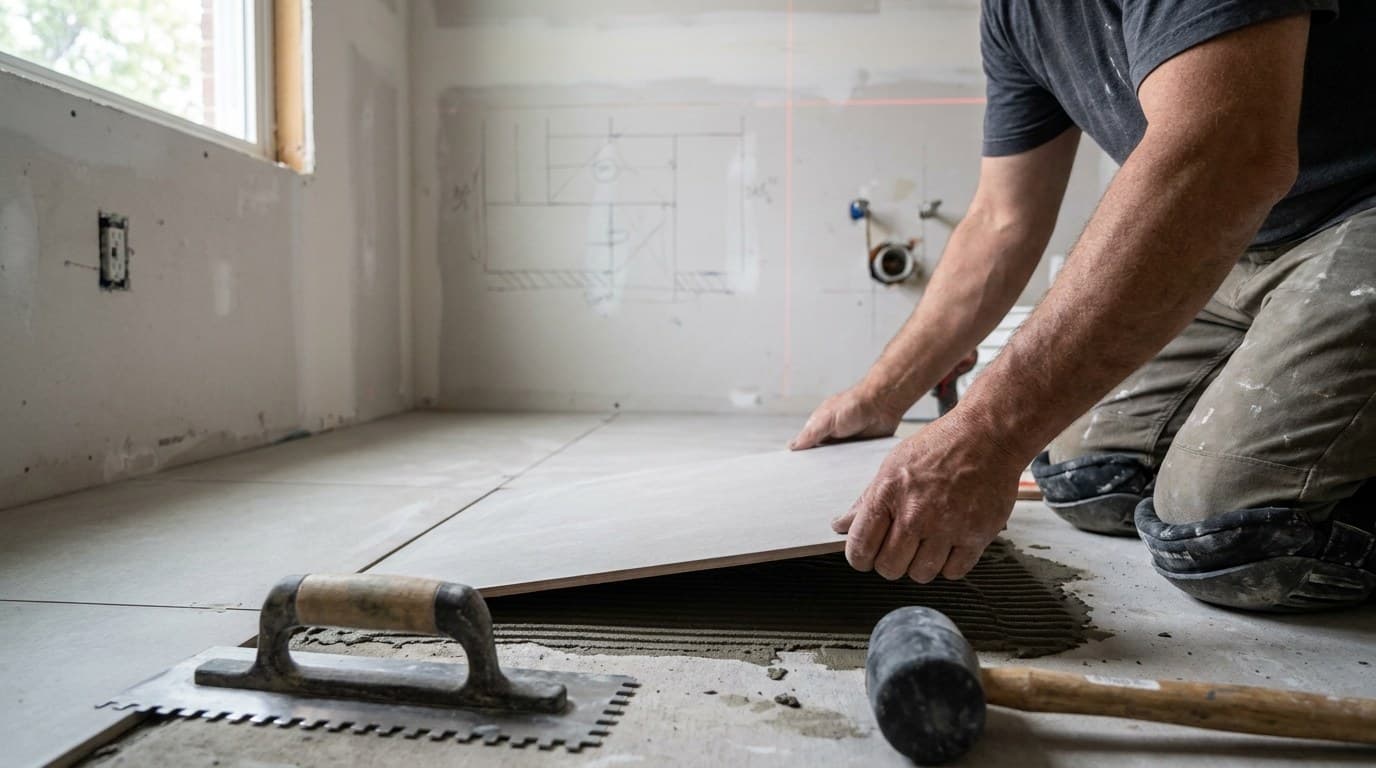
The bathroom remodel that goes sideways in Spring Lake usually was not sold to a bad customer. It was sold by a good salesperson and installed by the wrong installer. We get called in three to five times a year to look at tile work that failed inside two years: popped tiles, cracked grout, lippage on a kitchen backsplash, a shower pan that leaks into the ceiling below. The pattern is consistent. The homeowner picked the cheapest quote, the work was subbed out to whoever was free that week, and nobody on site actually understood waterproofing.
This is the conversation we wish every homeowner had before signing a tile contract. It applies whether you hire JL Tile & Stone or another installer. The point is to know what you're buying and walk away from the deals that look too good to be true, because they are.
How to Find a Reliable Tile Installer in New Jersey
The order matters more than the speed. Most homeowners do it backwards: they get one quick quote from someone a friend recommended, sign it, then discover on demo day that the installer brought the wrong substrate, has no plan for waterproofing, and is also doing two other jobs that week.
The right sequence is roughly this. First, define the scope yourself in writing: wet area or dry, square footage, tile size, layout pattern, any custom work like a curbless shower or a herringbone floor. Second, get two or three quotes from contractors who specialize in tile, not general remodelers who sub the tile work out. Third, verify each company's NJ Home Improvement Contractor registration and insurance certificates before any of them gets into your house. Fourth, look at recent tile work each one did within driving distance, either physical job sites or detailed photos with location. Fifth, compare scopes line by line, including substrate prep, waterproofing membrane, thinset spec, and grout type. Then sign.
That sequence weeds out almost every disaster. Skipping any single step is how the trouble starts. Especially the substrate prep step. That is where tile work either succeeds for thirty years or fails inside three.
What Questions Should You Ask a Tile Contractor Before Hiring?
Eight questions. Bring them written down. Watch how the answers come.
- What is your NJ Home Improvement Contractor license number? Every legitimate contractor in New Jersey has one starting with 13VH. They should rattle it off without checking their phone. The state runs a free public lookup at the NJ Division of Consumer Affairs site. Verify before you sign.
- Can you email your liability insurance certificate and your workers' comp certificate before the demo? Both, not one or the other. General liability covers your house if a wet saw rolls into a wall. Workers' comp covers your liability if an installer gets hurt in your bathroom. Without workers' comp, that injury becomes your homeowners' policy's problem.
- Do you do tile installation as your primary trade, or do you mostly do general remodeling and sub the tile out? Generalists who sub tile work do not consistently produce great tile work. Specialists do. Ask directly. The answer should be clear.
- What waterproofing system will you use, and why? For wet areas (showers, tub surrounds, steam rooms, pool surrounds), the answer should be specific: Schluter Kerdi, Laticrete Hydro Ban, RedGard, or similar. "Backerboard with a vapor barrier" is not waterproofing on a modern shower. If the answer is vague, walk.
- Can I see three tile jobs you completed in this town in the last 12 months? Local, recent, specific. Photos with addresses or job sites you can drive past. Not a list of names with no detail. A real tile installer in Monmouth or Ocean County can hand you a list.
- How do you handle tile selection, and who is responsible for ordering? Some installers source the tile through a distributor. Some have you buy it and bring it in. Both are fine, but mixing them mid-project causes tracking problems and warranty gaps. Get clear on this before signing.
- What's the workmanship warranty, and what does it cover? Five years minimum on a residential install. Two-year warranties are light. The warranty should cover lippage, popping, grout failure not caused by movement, and waterproofing failures on wet installs. Get it in writing on the contract. Verbal warranties don't survive year three.
- What happens if you find rotted subfloor or a non-flat substrate during demo? The honest answer: there's a per-square-foot upcharge for substrate repair, billed transparently, and we don't proceed without your sign-off. The wrong answer is "we cover anything that comes up." That bid is hiding the cost somewhere you'll find out about on day three.
The questions matter, but how the answers come matters more. A real tile installer with twenty years on residential New Jersey work will answer all eight without checking notes. The cagey ones tell you what you want to hear and skip the specifics.
Red Flags When Hiring a Tile Contractor
The patterns we see when we get called to fix someone else's bad tile work:
- "We don't need to remove the old subfloor." Sometimes you don't. Often you do. A contractor who tells you on a kitchen rip-out that they're laying new tile over existing 5/8" plywood without verifying flatness or movement is setting up a cracking problem. Ask how they're checking deflection.
- "Backerboard is the same as waterproofing." It is not. Cement board is a substrate, not a waterproofing membrane. Modern wet-area tile installs use a sheet membrane (Kerdi, Hydro Ban Sheet) or a liquid membrane (RedGard, Laticrete Hydro Ban). If a contractor claims backerboard alone is "waterproof," they are wrong, and your shower will be a problem within five years.
- Quote on the back of an envelope. A real tile quote runs three to seven pages: substrate spec, waterproofing system, thinset product, grout product, tile layout pattern, edge treatment (Schluter, bullnose, mitered), payment schedule, dates, signatures. If it's not itemized, you can't compare it.
- Cash-only or 50% deposit. NJ caps contractor deposits at one-third of the project cost or $1,000, whichever is less, on most home improvement contracts. Anyone asking for half up front is either ignoring the law or planning to disappear. Pay by check, not cash, and keep the receipts.
- "Material warranty" instead of "workmanship warranty." Tile manufacturers warranty their tile. That covers material defects only. It does not cover lippage, poor layout, or popped tiles. A contractor offering only a material warranty has shifted all the install risk to you.
- Pressure to sign today. Real quotes are good for 30 days. Anyone telling you the price is only good if you sign before they leave the kitchen is either trying to lock you out of comparison shopping or hiding something in the fine print.
- Bid is way below everyone else. If three legitimate local contractors are within 10% of each other and a fourth is 30% lower, the fourth is leaving something out. Open the quote and find what's missing. Usually it's the waterproofing membrane, the substrate prep, the schluter edges, or the workmanship warranty.
- "It's not in our scope, but the homeowner can handle it." Demo, plumbing rough-ins, drywall repair and vanity install are all jobs that can sit between trades. A real tile installer tells you who handles each piece on the timeline. A bad one shifts coordination problems to you and disappears between phases.
Reading the quote carefully and asking what's missing tends to surface most of the red flags before they cost you money. We covered the related failure modes in our shower tile cracking guide, and most of those problems trace back to which contractor was hired, not which tile was selected.
Tile Installer vs. Handyman: What's the Difference?
This is the question we get most often from first-time remodelers. Why pay a tile specialist when a handyman quote is half the price?
Honest answer: handymen are useful for many jobs. Tile installation is rarely one of them. The difference shows up in seven places:
| Skill area | Tile specialist | General handyman |
|---|---|---|
| Substrate flatness | Will self-level a floor or feather-finish drywall before laying. Has the tools. | Often skips this step. Lays tile on whatever is there. |
| Waterproofing wet areas | Specifies and applies a real membrane system. Tests it before tile. | Uses backerboard alone or a thin coat of mastic. |
| Layout planning | Plans grout lines, cuts, and end conditions before any tile gets cut. Avoids slivers. | Starts at one corner and works across. Slivers wherever the wall ends. |
| Thinset selection | Picks based on tile size, substrate, and application. Has multiple types on the truck. | One bag of premixed mastic for everything. |
| Edge treatment | Schluter profiles, mitered corners, or bullnose. Clean transitions to other materials. | Caulk in the corner. Often the wrong color. |
| Tools | Wet saw, leveling system, tile clips, manual cutter, multiple trowels. | Wet saw rental for the day if it's a small job. |
| Warranty | Five-plus years on workmanship in writing. | "Call me if there's a problem." |
A handyman tile install on a small backsplash in a low-stakes powder room sometimes works. A handyman tile install on a primary shower or a kitchen floor in a Monmouth County home is asking for a callback inside three years. We've replaced enough of these to be confident: the cheap install costs more than the right install once you account for the second job.
How Many Quotes Should You Get for a Tile Installation?
Three is the right number. Two is not enough. There's no triangulation, and if both quotes are wrong in the same way you have no idea. Four is too many. You start wasting your weekends comparing trim profiles and you've lost six weeks before signing.
The three quotes should come from contractors with similar profiles: licensed, insured, tile-specific (not general remodeling), local (Monmouth or Ocean County for shore-area work, with experience in your specific climate), and within 10 years of comparable experience. If you mix in a generalist's quote, the price gap won't be informative. You'll just see the lower number and not understand why.
When the three quotes come in, lay them side by side and compare:
- Substrate prep. All three should specify what they're doing. Self-leveling, feather coat, full demo to subfloor, etc.
- Waterproofing system. Wet areas only, but if the quote is silent, ask. Schluter Kerdi vs. Hydro Ban vs. RedGard are real differences in cost and lifespan.
- Thinset and grout product names. Not "high-quality thinset." Brand and product line.
- Grout type. Cement-based vs. epoxy. Epoxy costs more, lasts longer in wet areas, and is harder to install. If only one of three quotes specifies epoxy in a shower, you've found a real difference.
- Layout plan. Specifically: where are full tiles, where are cuts, what edge treatment.
- Workmanship warranty. Length and what it covers.
- Payment schedule. Deposit, progress payment, final payment. Compare against NJ legal limits.
- Timeline. Demo through grout finish. Realistic for a bathroom shower is 5-10 working days. A quote claiming three days for a full master shower is almost certainly skipping the cure times, since thinset and grout both need 24-48 hours minimum.
Once the scopes are matched up, the price difference shrinks. The quote that was 20% cheaper now ties or beats the others when you account for what was missing. That's the whole reason for getting three quotes: to understand which scope is honest, not to find the cheapest. Then pick on workmanship, references, and feel.
If you're planning a bathroom remodel in Monmouth or Ocean County and want a quote that's itemized, transparent, and stands for every check above, we'll come look at the space, take measurements, and send you a written proposal within 48 hours. We install tile up and down the shore, in Spring Lake, Sea Bright, Asbury, Ocean Township, Belmar, Long Beach Island, Lavallette, Toms River, Manasquan, Brielle. Local matters because the failure modes of shore-area tile work are specific to coastal moisture, freeze-thaw, and sand abrasion. Our cost-of-remodel guide covers what the project should run; this guide covers who you should hire to do it. If you are still deciding between a custom tile shower and an acrylic surround before you even pick a contractor, our tile shower vs acrylic surround breakdown walks through the cost, life, and resale math honestly. Reach out when you're ready and we'll set up a walk-through.