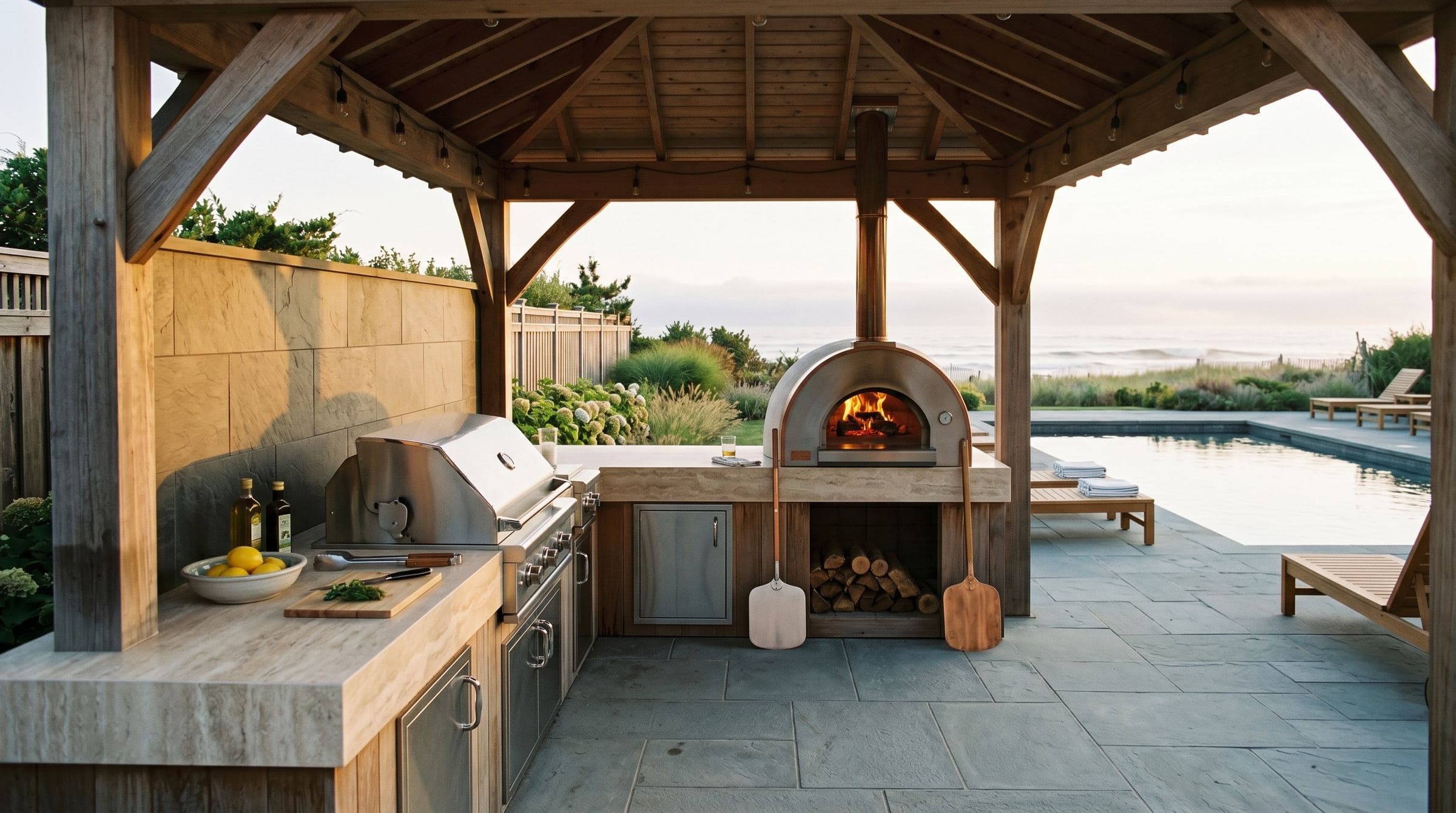
Every June we walk a handful of Monmouth and Ocean County backyards where the homeowner is finally ready to do the outdoor kitchen they have been talking about for three years. Sometimes it is a Bay Head pool house addition. Sometimes it is a Spring Lake covered loggia. Sometimes it is a Manasquan deck with a built-in grill cabinet and a pizza oven the family wants finished before the Fourth of July. Whatever the project looks like, the same question comes up early: what tile, what countertop, what backsplash will actually hold up at the shore.
The honest answer is that most of what gets installed in shore outdoor kitchens fails within five years. The products that look right in a Pinterest board for an indoor kitchen are not built for the conditions out here. Salt air, direct sun, hot grease, freezing winters, and the daily abuse of a working outdoor cookspot work against everything the average kitchen designer specs. The handful of products and methods that do survive a shore outdoor kitchen are not what a general remodeler defaults to. This is the rundown.
What an Outdoor Kitchen at the Jersey Shore Is Up Against
The product spec for an outdoor kitchen in Manchester or even Howell is one thing. The spec for the same kitchen in Mantoloking, Lavallette, or Long Beach Island is another. The coast adds load that the inland map does not. Five forces stack up on every horizontal and vertical tile surface in a working shore outdoor kitchen.
- Salt-laden air, year-round. Within five miles of the ocean, every porous surface absorbs salt. Salt corrodes metal hardware, eats lower-grade grout and cheaper sealers, and accelerates surface breakdown on porous stone.
- Direct, unbroken summer sun. Outdoor kitchens are usually built where the cookspot gets sun. UV bleaches pigmented grout, hazes lower-end glazes, and fades pigmented stone over time.
- Hot grease and acid spills. A working grill drops grease. Marinades, citrus, wine, and tomato sauce all hit countertops and backsplashes. Acid-sensitive stone shows etching in weeks.
- Freeze-thaw winters. The shore stays just cold enough through January and February that any moisture trapped in tile, grout joints, or countertop seams freezes and expands. Cracked counters and spalled tile faces are almost always freeze-thaw failures that started with water absorption.
- Wind-driven rain. Covered outdoor kitchens still get sideways rain in nor'easters. Anything that is not rated for full water exposure will absorb, hold, and eventually fail.
An inland tile and stone install that survives thirty years in a Princeton or Morristown backyard will fail at the shore in five if the product was wrong for the conditions. The spec change is not cosmetic. It is structural.
Countertops: The Single Most Important Surface
The countertop is the working surface, the most visible piece of the kitchen, and the part most homeowners get wrong. Three countertop options dominate the conversation at the shore, and they are not equal.
Through-body porcelain slab, 12 mm or 20 mm. The product we specify on almost every Monmouth and Ocean County outdoor kitchen we work on. A large-format porcelain slab, 12 mm or 20 mm thick, full slab fabricated to a single countertop run. Water absorption under 0.5 percent. UV stable. Acid resistant. Heat tolerant up to 1,200 degrees Fahrenheit, which means a hot pan from the grill goes straight onto the counter with no trivet. Color is through-body, so a chip never shows a different color underneath. Brands like Neolith, Dekton, and Lapitec make outdoor-rated slabs that are designed for this exact job. Pricier than granite per square foot. Worth it on every metric that matters for a shore install.
Granite, sealed correctly. A solid second choice for a shore outdoor kitchen, with caveats. Granite is dense enough to resist freeze-thaw, hard enough to take grill abuse, and acid resistant enough for citrus and wine. The catch is that granite needs an outdoor-rated sealer applied at install and reapplied every twelve to twenty-four months. Skip a season of sealing and the salt and grease start working into the surface. Granite also fades under direct sun over a decade, more visibly in darker stones. We spec granite when the homeowner has a strong preference or a tighter budget and will commit to the maintenance.
What we will not install outdoors. Marble, limestone, soapstone, and travertine. All four are acid-sensitive, and one summer of citrus and tomato is enough to leave permanent etch marks across the working surface. Quartz, the engineered surface that dominates indoor kitchens, is not rated for outdoor use. The resin binders in quartz break down under UV and yellow within two to three years on a sunny shore deck. Concrete counters are a maybe, but require expert pouring and sealing, and they crack at seams in freeze-thaw. None of these belong in a working shore outdoor kitchen.
Backsplash Tile: Where Most Installs Go Wrong
The backsplash on an outdoor kitchen is the vertical surface behind the grill, the burner, or the pizza oven. It takes grease splatter, smoke residue, hot wind, and direct sun. Most shore outdoor kitchens get this wrong by using a beautiful indoor-rated tile and assuming the install will be sheltered enough to compensate. It almost never is.
The spec we use:
- Through-body porcelain rated for exterior use, water absorption under 0.5 percent. Glazed porcelain works if the glaze is fired at high enough temperatures to be chemical-resistant. Cheap glazed ceramic does not.
- Large format tile, 12x24 or larger, to minimize grout joints. Every grout joint is a weak point for water absorption and salt residue.
- Rectified edges set with 1/16 inch grout joints to reduce joint exposure further.
- Modified thinset rated for exterior bond and freeze-thaw, not a stock indoor adhesive.
- Epoxy grout or a high-end urethane grout, never standard cementitious grout. Epoxy grout shrugs off grease, acid, salt, and freeze cycles. Cementitious grout stains and crumbles within three to five years outdoors.
We see installers default to standard sanded grout on outdoor backsplashes constantly. The job looks beautiful at the punch list and starts crumbling between the tiles the second winter. Epoxy or urethane grout is not a luxury upgrade on a shore outdoor kitchen. It is the spec.
Floor Tile Under and Around the Cookspot
The floor of the outdoor kitchen zone, the area under the grill, in front of the cabinets, and stepping out from the cook space, is high-wear ground. Hot grease drops here. Wet feet from the pool track in. Anything heavier than a wine bottle eventually gets dropped on it.
Our spec on shore outdoor kitchen floors is 2-cm porcelain pavers, the same product we use on pool decks. Through-body color, UV stable, freeze-thaw rated, available in slip-rated finishes for wet barefoot traffic. The advantage of 2-cm pavers over thinner tile is that they can be pedestal-set, sand-set, or mortar-set, which gives the installer flexibility on a deck or patio that may not be perfectly level. Brands like Mirage, Coverings, Florim, and Belgard all make outdoor-rated 2-cm porcelain lines built for this.
Avoid bluestone in the immediate cookspot zone. Bluestone is beautiful and durable on a patio, but the porous surface absorbs grease, and grease stains on bluestone are nearly impossible to remove. Bluestone is fine on the perimeter of the outdoor kitchen. Not under the grill.
Pizza Oven and Wood-Fired Surrounds
Pizza ovens are the fastest-growing piece of every shore outdoor kitchen build we have done in the past three years. The masonry of the oven itself is built by the oven manufacturer or a brick mason. The tile and stone surround, the hearth, the surrounding cabinetry, is where we come in.
The key spec on pizza oven surrounds is heat tolerance. The face of a working pizza oven runs hot, and the cabinetry within four to six inches of the oven door takes direct heat exposure. Standard tile and stone can crack under repeated heat cycling. We spec the same through-body porcelain we use for countertops, in a 12 mm thickness, with high-temperature thinset and epoxy grout. The result is a surround that handles the heat cycle without crazing, cracking, or grout failure.
The hearth in front of the oven, where embers can land and cinders can fly, needs a non-combustible surface. Porcelain pavers, dense granite, or specialty firebrick are all acceptable. Wood, even hardwood, is not.
Cabinetry, Cladding, and the Hidden Failures
The visible tile and counter surfaces get most of the attention, but the failures we get called back to fix at the shore are usually behind the surface. A working outdoor kitchen has cabinetry, doors, drawers, plumbing, and gas hookups that all need to be built for the conditions.
- Stainless cabinets rated for outdoor use, ideally 304 grade or higher. Marine-grade 316 is overkill for a covered loggia and the right answer for an exposed deck within a mile of the ocean.
- Stone or porcelain cladding on cabinet faces, set on cement board with corrosion-resistant fasteners. Plywood and gypsum sheathing have no place in an outdoor kitchen.
- Concrete or stone hardscape base below the cabinet line. The cabinet should not sit on a wood deck. It should sit on a poured pad or set into a hardscape surround that drains.
- Drainage and slope built into the floor under the cookspot. Water needs to leave the surface, not pool against the cabinet base.
The hidden details are where ten-year outdoor kitchens differ from three-year outdoor kitchens. We have torn out enough early failures across Ocean County to know which corners get cut and what happens when they do.
What This Costs at the Jersey Shore
Budget honestly. A working outdoor kitchen built to a shore spec, with through-body porcelain counters, full backsplash, floor pavers, pizza oven surround, stainless cabinetry, and proper hardscape base, is not a $5,000 project. A small L-shaped cookspot with grill and modest counter runs $20,000 to $35,000 in materials and labor on the lower end. A full kitchen with pizza oven, prep zone, beverage station, and surround patio runs $60,000 to $120,000 and up depending on size and finish level.
The savings come on the back end. A correctly built outdoor kitchen at the shore lasts twenty to thirty years with sealing every two years and one or two service calls along the way. The wrong spec, the indoor-grade products and the wrong grout, will need replacement of the visible surfaces by year five and a full rebuild by year ten. The math favors doing it right the first time, every time, on a shore property.
Working with Us
We tile outdoor kitchens, pool surrounds, patios, outdoor showers, and full backyard hardscape across Monmouth and Ocean County. Every project starts with a walk of the site, a conversation about how the space will be used, and a written spec that names the product brand, the install method, and the warranty on every surface. If you are planning an outdoor kitchen for this summer or next, the time to spec it is now. The summer install season fills up by mid-May, and a serious build needs four to eight weeks of fabrication and install time depending on scope.
If your existing outdoor kitchen is showing failures, spalled counter edges, cracked backsplash tile, lifted floor pavers, etched stone surfaces, we walk it for free and tell you honestly whether it is a repair or a tear-out. Sometimes it is a clean repair. Sometimes the original spec was wrong and the only honest answer is to start over with the right materials. Either way, you leave the walk-through with a real number and a real plan, not a sales pitch.