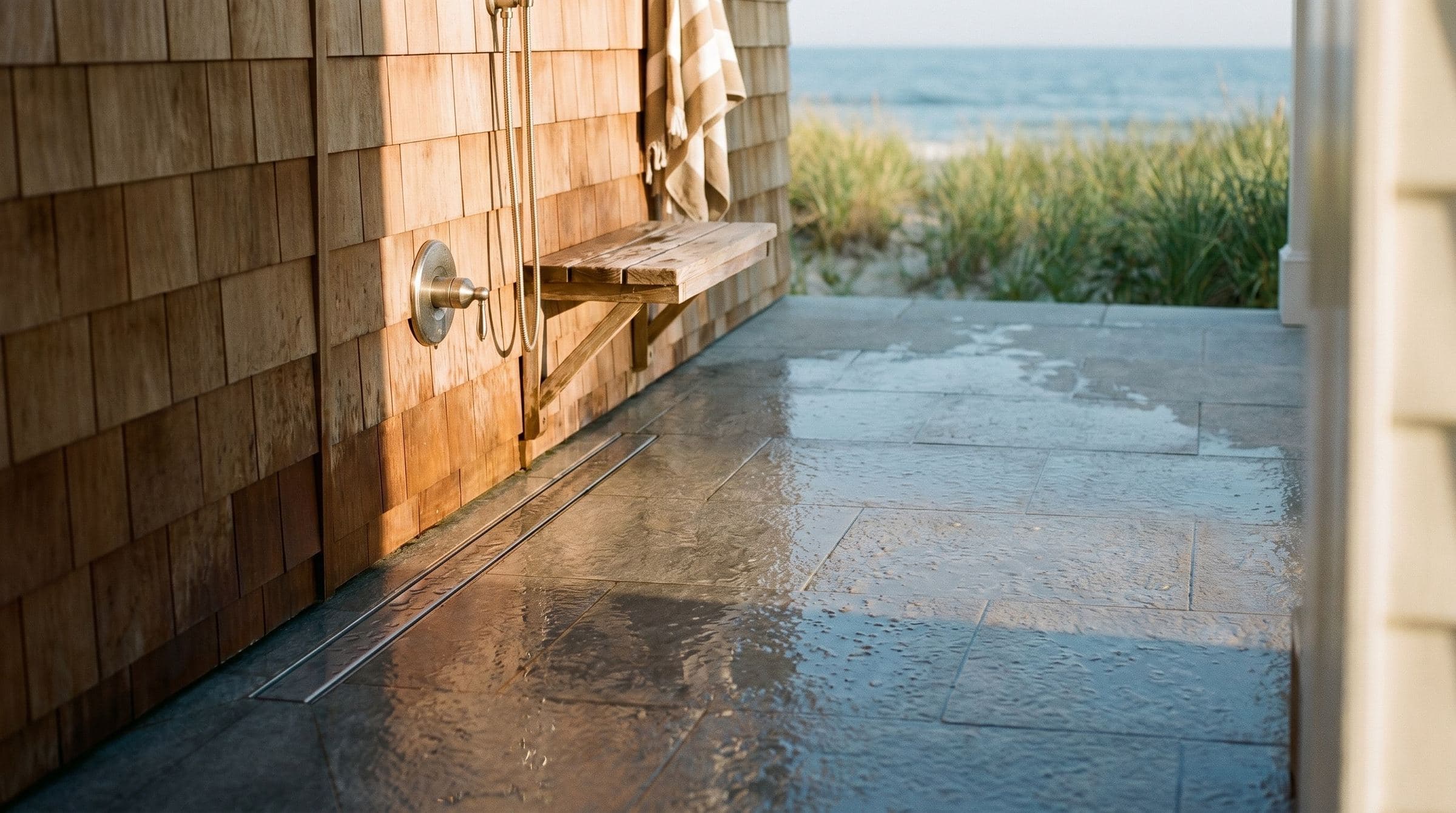
Outdoor shower season starts the second weekend of May at the Jersey Shore. Every house from Sea Bright down to LBI flips the water back on, and within three weeks the homeowners with the wrong tile are looking at chipped corners, cloudy grout, soft spots, and at least one tile that has popped loose entirely. We get more "can you come look at the outdoor shower" calls in the first two weeks of June than at any other point in the year.
Outdoor showers are the single hardest tile environment in coastal NJ. Harder than pool surrounds. Harder than patios. Harder than steam showers. They take everything an outdoor patio takes plus daily flooding, sunscreen oils, sand abrasion, and minimal drying time between uses. Most of the tile sold for outdoor showers along the shore is not actually built for what an outdoor shower goes through.
We install and repair outdoor showers across Monmouth and Ocean County, from Spring Lake to Lavallette to Long Beach Island. Here is the honest playbook for what works, what fails, and what to look at before you commit to a tile.
Why Are Outdoor Showers So Hard on Tile?
Five things stack on the same surface, every day, all summer:
- Daily flooding. A typical shore outdoor shower runs four to twelve cycles a day in season. The floor is wet for sixteen hours and dries for eight, every day, for fifteen weeks straight.
- Sand abrasion. Beach sand is mostly quartz. It is harder than every common tile glaze and most natural stones except granite. Sand scuffs, dulls, and over time grinds glaze off any tile that is not full-body.
- Salt air plus saltwater rinse-off. The same Atlantic salt that destroys patio tile is now being concentrated and pushed into grout joints by daily showering.
- Sunscreen and oils. Modern reef-safe sunscreens contain zinc oxide and avobenzone. Both stain unsealed natural stone and porous grout permanently.
- Freeze-thaw. Outdoor showers rarely get fully winterized in coastal NJ second homes. Water sits in joints and substrate through 50 plus freeze-thaw cycles every winter.
An outdoor shower experiences in one summer what a typical indoor bathroom experiences in five years. Specifying tile rated for "outdoor use" is not enough. The spec needs to handle this specific environment.
Which Tile Materials Actually Survive an Outdoor Shower at the Shore?
The list is short and most of the showroom samples are not on it.
| Material | Salt + Sand | Freeze-Thaw | Sunscreen Stain | Cost per sq ft (installed) |
|---|---|---|---|---|
| Full-Body Porcelain (R11 anti-slip) | Excellent | Excellent | Excellent (non-porous) | $24 - $42 |
| Dense Granite (flamed finish) | Excellent | Excellent | Very Good (sealed) | $32 - $55 |
| Pebble Mosaic on Porcelain Backing | Good | Good | Fair (grout staining) | $22 - $36 |
| Travertine | Poor | Poor | Poor (etches) | $18 - $32 |
| Bluestone | Fair | Good | Fair (oils stain) | $22 - $42 |
| Standard Glazed Ceramic | Poor | Poor | Good | $10 - $18 |
| Marble or Limestone | Very Poor | Very Poor | Very Poor | Do not use |
For nine out of ten outdoor showers we build along the Monmouth and Ocean County coast, full-body porcelain in an R11 anti-slip finish is the right answer. It is non-porous, immune to sunscreen oils and salt, durable against sand abrasion because the color is through-body (chips do not show a different colored body underneath), and rated for freeze-thaw at coastal NJ severity. We also pair it with the right grout, which is the part most installs get wrong.
Why Most Outdoor Shower Tile Fails Long Before the Tile Itself Wears Out
Nine times out of ten when we tear out a five-year-old outdoor shower in Mantoloking or Bay Head, the tile itself is fine. The grout is gone, the substrate is rotting, or water has been trapped behind the wall for three years. Tile failure in outdoor showers is almost always an install problem, not a tile problem.
The three things that fail first:
- Cement-based grout. Standard sanded cement grout absorbs water, holds salt, harbors sunscreen oils, and freeze-thaws into powder by year three. Use single-component urethane or epoxy grout in every outdoor shower. Yes, it costs more. It is the difference between a shower that holds up for fifteen years and one that needs regrouting at year four.
- Substrate. Cement board over plywood is not enough. Outdoor showers need a fully waterproofed substrate (Schluter Kerdi-Board, Wedi, or equivalent uncoupling and waterproofing membrane) over treated framing with a continuous drainage plane behind the wall. We have torn out brand-new outdoor showers where the contractor skipped waterproofing because "it is open to the air, it will dry." It does not dry. Water gets trapped against the framing for months.
- Drainage. The slope to the drain matters more in an outdoor shower than anywhere else because there are no walls forcing water down. We see installs where the floor pitches toward the entry, washing water and sand into the path of bare feet. Minimum 1/4 inch per foot slope to a properly sized drain, every time.
What Should an Outdoor Shower Floor Look Like?
The floor takes the worst abuse. Anti-slip rating matters here in a way it does not on a covered patio. The DCOF (dynamic coefficient of friction) rating you want is 0.42 or higher when wet, ideally 0.55. R11 in the European rating system is the equivalent benchmark.
Three formats we install most often for outdoor shower floors at the shore:
- Small-format porcelain mosaics (1 to 2 inch squares). The grout joint density is the anti-slip mechanism. Easy to keep level, easy to slope to a center drain, and durable if the right grout is used. Good for traditional shower-only spaces.
- Full-body porcelain pavers (12x24 or larger) with R11 textured finish. Cleaner look, more contemporary, fewer grout lines to maintain. Requires a linear drain and a precise slope. Our preferred floor for newer construction in towns like Mantoloking, Sea Girt, and Bay Head.
- Pebble mosaic over a porcelain mesh. Beachy look that fits older shore homes. Functional but the grout joints are dense and need proper urethane or epoxy grout to avoid mildew.
Avoid large-format anything below R10 on an outdoor floor. We have replaced multiple polished travertine and large-format ceramic floors that were dangerous in the second week of use. Slip risk is liability risk, especially at a rental property.
How Do You Maintain an Outdoor Shower So It Lasts?
The right tile and the right install do most of the work. The maintenance side is mostly about keeping water moving and intervening once a year.
- Rinse the floor with fresh water at the end of each day. Thirty seconds with a hose. This single habit removes the salt and sunscreen residue that does the long-term damage.
- Reseal grout (if cement-based) every spring. If you have urethane or epoxy grout, you can skip this. If you inherited a shower with cement grout, sealing every spring buys time until you can regrout.
- Winterize the plumbing every fall. Blow the lines out before the first hard freeze. Ice expansion in the lines cracks the valve body, which is the most common winter failure on shore outdoor showers.
- Check the substrate each May. Press on lower wall areas with the heel of your hand. Any softness or hollow sound means water is getting behind the tile and the wall is rotting. Catch it early and a section repair is a one-day job. Ignore it and it becomes a full rebuild.
What Does an Outdoor Shower Cost in Monmouth and Ocean County?
Real numbers from work we did in 2025 and the first quarter of 2026:
- Basic outdoor shower (3x4 footprint, simple porcelain floor and walls): $4,500 to $7,500
- Mid-range with stone trim, full enclosure, hot/cold valve, and bench: $8,500 to $14,000
- High-end natural stone (granite or full bluestone), custom millwork enclosure, integrated lighting: $16,000 to $30,000+
The single biggest variable is whether the framing and waterproofing have to be redone. A tile-only refresh on a properly built enclosure runs at the low end of these ranges. A full rebuild because the substrate has rotted out runs at the high end.
What to Do This Month If Your Outdoor Shower Is Already Showing Wear
Walk the shower with a flashlight before Memorial Day. Look at:
- Grout joints. Are they soft, missing, or stained dark in the corners?
- Floor slope. Pour a cup of water in the four corners. It should all reach the drain in under thirty seconds.
- Wall flex. Press firmly on the lower 18 inches of every wall. Any movement means the substrate is gone.
- Valve and plumbing. Run the shower for two minutes. Look for any drips or slow leaks at the valve body.
- Tile chips and pop-outs. Note which tiles need replacement and where.
If the structure is solid and the tile is mostly intact, a regrout, reseal, and a few replaced tiles can buy you another five to ten seasons. If the substrate is soft or the floor does not drain right, plan a rebuild for the fall when the season is over and contractors are easier to schedule. We covered the broader question of what survives the shore environment in our outdoor patio tile guide for the Jersey Shore, and the same logic applies (only more so) to outdoor showers.
If you want a real assessment on a specific outdoor shower in Monmouth or Ocean County, send us a few photos and a short video of the floor draining. We will tell you honestly whether the shower has another five years in it, whether a regrout is enough, or whether you should plan a fall rebuild before next season hits.