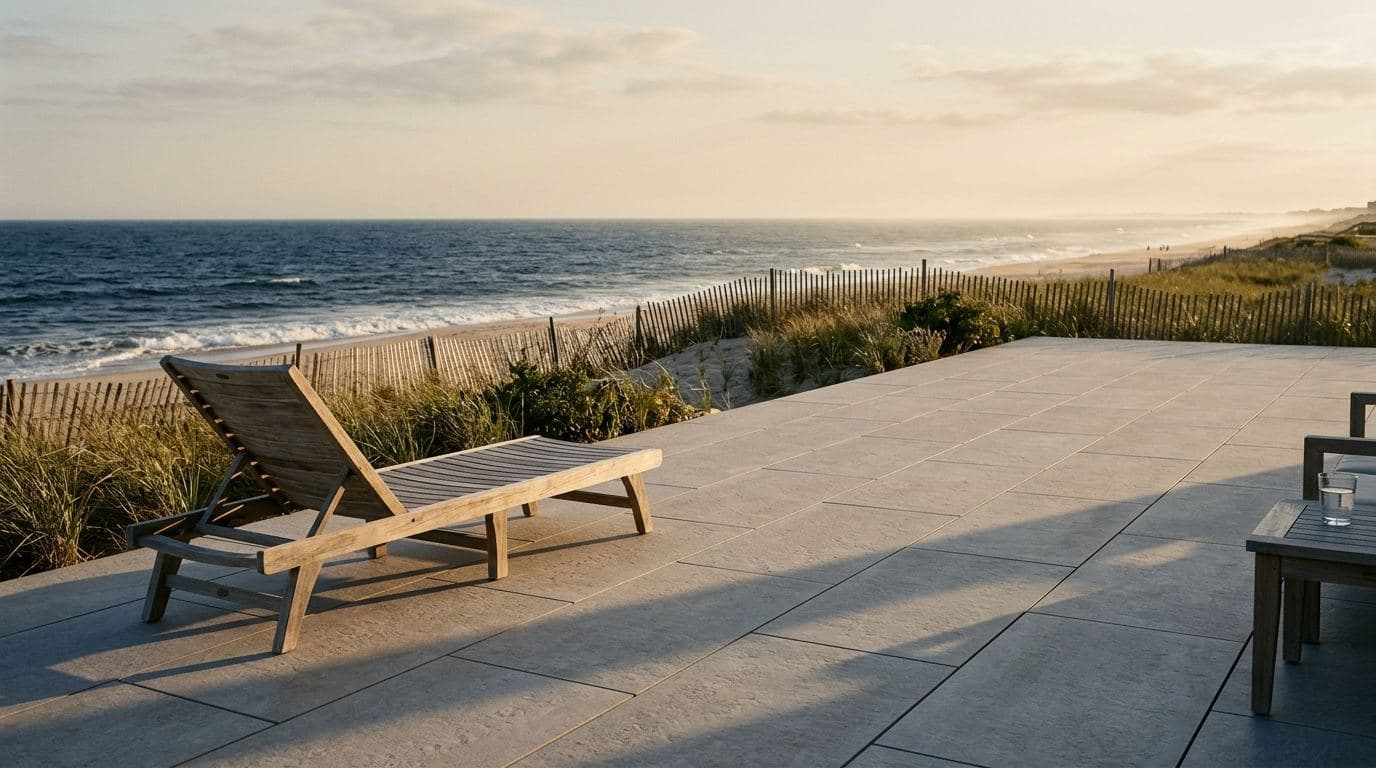
It's late April, the patios are finally dry, and every other homeowner in Monmouth and Ocean County is looking at last summer's tile and wondering why it looks ten years older than the install date on the receipt. The honest answer is that most of the tile sold for outdoor use along the Jersey Shore is not actually rated for the conditions it lives in. Salt air, freeze-thaw cycles, and standing rain in shaded corners destroy the wrong product fast.
We have replaced outdoor tile in homes from Sea Bright down through Bay Head, Lavallette, and Long Beach Island, and the failure pattern is almost always the same. Spalling. Hairline cracks in the body. Joint sand washed out. Edges chipped from foot traffic and patio furniture. Every time, the tile spec was wrong for the environment, even when the homeowner was sold it as "outdoor rated."
Why Is Outdoor Tile So Hard at the Jersey Shore?
Three factors combine to punish patio surfaces along the shore in a way that inland NJ patios never see:
- Salt air corrosion. Onshore wind carries airborne sodium chloride miles inland. It crystallizes inside any porous tile or grout joint and expands during temperature swings. We see measurable salt damage on tile installed within ten miles of the ocean. Past five miles it accelerates noticeably.
- Freeze-thaw cycles. Coastal NJ averages 50 to 70 freeze-thaw events per winter. Every event flexes whatever moisture sits in the tile body or behind it. Tile with even 0.5% water absorption fails inside a few seasons.
- UV plus thermal shock. Summer surface temps on dark patio tile in direct shore sun hit 140 degrees. A sudden afternoon thunderstorm drops that 50 degrees in minutes. Most ceramic and natural stone cannot handle that swing year after year.
Which Outdoor Tile Materials Survive Shore Conditions?
The honest list is short. We install outdoor tile across Monmouth and Ocean County and there are really only three categories worth specifying near the water:
| Material | Salt Resistance | Freeze-Thaw | Maintenance | Cost per sq ft (installed) |
|---|---|---|---|---|
| Full-body Porcelain Pavers (2 cm) | Excellent | Excellent | Very low | $22 - $38 |
| Dense Granite | Excellent | Excellent | Low (seal every 3 years) | $28 - $50 |
| Quartzite (true, not soft) | Very Good | Very Good | Medium (seal yearly) | $30 - $55 |
| Travertine | Poor near ocean | Fair | High (seal twice yearly) | $18 - $32 |
| Bluestone | Fair | Good | Medium | $22 - $40 |
| Standard Outdoor Ceramic | Poor | Poor | Low until it cracks | $10 - $18 |
The single best choice for most shore patios is 2 cm full-body porcelain pavers. They are dense enough to survive salt and freeze-thaw, heavy enough to install on a pedestal system or a sand set base, and the through-body color means a chip from a dropped grill grate does not expose a different colored body underneath. We install a lot of these in Mantoloking, Spring Lake, and Bay Head where homeowners want a high-end look that handles the environment.
Travertine needs its own warning, because it fails faster at the shore than inland. It is one of the most-marketed outdoor tile choices in NJ and one of the most common things we tear out at the shore. The problem is that travertine is calcium carbonate. Salt air reacts with calcium carbonate and slowly etches the surface. Inland in Manalapan or Howell, sealed travertine can last fifteen years. In Sea Girt or Lavallette, it shows visible degradation in three to five years even with twice-yearly sealing.
If a homeowner is set on travertine, we tell them honestly: travertine works further from the water. Within ten miles of the ocean, plan on replacing it sooner or accept the patina. Within two miles, do not install it for a finished look that has to last.
What Setting Method Should You Use for Shore Patios?
The setting method matters as much as the tile choice. We see three approaches:
- Pedestal system on a flat roof or finished concrete pad. Tiles sit on adjustable pedestals with no mortar. Water drains underneath, joints are open, salt cannot trap. Best for second-story decks, rooftop patios, and any flat structure where drainage is critical. We use this on a lot of Bay Head and Mantoloking projects.
- Sand-set on compacted aggregate base. Traditional paver install method. Works well for larger patios and walkways. Joint sand needs polymeric to resist washout. Allows individual tile replacement if anything ever fails.
- Mortar-set on concrete slab. Best for tightly fit large-format porcelain look. Requires a properly sloped, expansion-jointed slab and exterior-rated thinset. Done wrong, every freeze-thaw cycle pops tiles. Done right, lasts twenty-plus years.
Most failures we see at the shore are from method 3 done by a contractor who used interior thinset, skipped expansion joints, or set tile directly on a concrete slab without checking moisture content. The correct exterior install on a slab is a specific specification that costs more on the front end and pays back over decades.
What Grout and Joint Material Survives Salt Air?
Cement grout is the single fastest failure point in shore patio tile. It absorbs salt water, crystallizes, then erodes from the joint. Within three to five years the joints are gone and tiles start moving.
For shore installations we specify either:
- Epoxy grout for mortar-set installations. Non-porous, salt-resistant, does not need sealing. Costs about three times standard cement grout but lasts the life of the patio.
- Polymeric sand for sand-set pavers. Mixed with a polymer that hardens when wet, resists washout, allows joints to flex.
- Open joints with pedestals for any flat-deck application. No grout means no failure point.
Skipping the upgrade from cement to epoxy grout to save a few hundred dollars on a $20,000 patio is the most common false economy we see in NJ. The grout is the patio. When it fails, everything else moves.
What About Pool Decks?
Pool decks add chlorinated water and constant wet-foot traffic to the salt-air problem. The tile spec changes:
- DCOF 0.42 minimum, 0.55 preferred for slip resistance when wet. Polished anything is dangerous around a pool.
- Light to mid-tone color to manage surface temperature. Dark gray porcelain in direct sun burns bare feet. We use a lot of warm beige and oyster-toned porcelain for pool surrounds in Brick, Toms River, and Forked River.
- Chlorine-resistant grout if grout is used. Epoxy is the only correct choice within four feet of the water line.
- Coping that matches. Use the same porcelain or a complementary stone for pool coping. Mismatched coping is the giveaway that a job was value-engineered.
Common Outdoor Tile Mistakes We Fix Every Spring
Every April we get calls from homeowners who watched their patios deteriorate over the winter and want to know what went wrong. Most fall into one of these patterns:
- Interior tile installed outside. The big-box store sold it as "porcelain" without explaining it was a 1.0% absorption ceramic-porcelain blend. Water gets in, freezes, pops tiles within two seasons.
- No expansion joints in long mortar-set runs. Tile expands and contracts. Without expansion joints every 10 to 12 feet, something cracks. Usually the tile, sometimes the slab.
- Wrong slope. Outdoor tile patios need 1/4" per foot slope away from the house. We see flat patios all the time and they pond water against the foundation.
- Wrong sealer. Topical sealers on outdoor stone trap moisture. Use only penetrating sealers for shore patios. Topical product fails inside a single winter.
For interior tile that takes seasonal abuse, we covered the equivalent breakdown in our mudroom and entryway tile guide. The principles are similar but the failure modes are different because outdoor tile faces UV and freeze-thaw the interior never sees.
What Outdoor Tile Costs Installed in Monmouth and Ocean County
For a 400 square foot patio, fully demoed and installed, we typically quote:
- Pedestal-set 2 cm porcelain pavers: $14,000 - $18,000
- Sand-set porcelain or stone: $11,000 - $16,000
- Mortar-set on existing slab: $9,000 - $14,000 (assuming the slab is sound)
- Mortar-set with full slab pour: $18,000 - $26,000
Pricing depends on accessibility, slab condition, tile selection, and how complex the layout is around stairs, pillars, or pool features. A simple rectangle is much cheaper to install than a curved patio with a built-in fire pit and stair access.
The Right Time to Plan a Patio in NJ
Most homeowners call us in June wanting their patio finished by July 4th. The reality is that good outdoor tile installs require dry weather, mortar that cures correctly, and slab moisture below 4%. May and June are wet months in NJ. July and August are the best install windows. September into early October is also excellent. Booking starts in January for the next summer if you want premium materials and an unrushed install.
If you are planning a patio this season and you live anywhere from Sandy Hook down to LBI, reach out for a walkthrough. Bring photos of the existing space and a rough idea of how you want to use it. We will tell you which materials make sense for your specific exposure and which ones to skip even if the showroom recommended them.