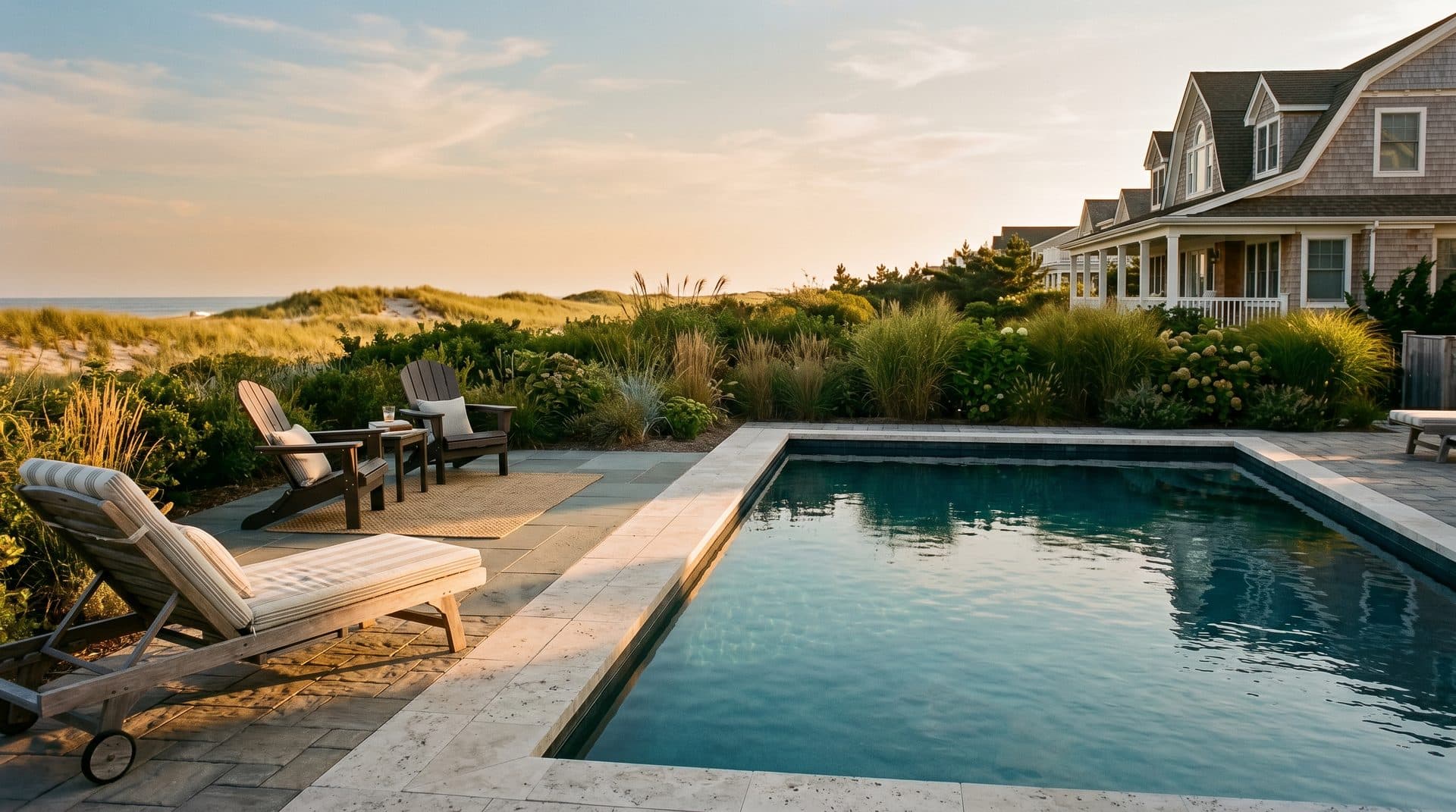
Pool season at the Jersey Shore opens with Memorial Day and runs hard through Labor Day, and every June we get the same call: the coping on a pool installed three or four years ago is spalling, the deck tile is lifting at the joints, or the homeowner just bought a house in Spring Lake or Sea Girt and the previous owner's pool deck is already failing. Pool surrounds at the shore live one of the hardest lives of any residential tile install. They take direct sun all summer, salt air year-round, chlorine and pool chemicals constantly, the freeze-thaw cycle every winter, and pool-deck foot traffic from wet bare feet all season long. There is no other residential surface that has to survive all five at once.
That punishment is the reason most pool deck tile and coping jobs at the shore fail early. The tile selection was wrong for the conditions, the install was a standard exterior tile install instead of a real pool install, or both. This is the post we wish every homeowner in Monmouth and Ocean County putting in a new pool or refinishing an old one read before signing for the surround. The product choice and the install methods that hold for thirty years on a Bay Head or Manasquan pool are not what a general tile crew would default to. Here is what actually works at the shore.
Why a Jersey Shore Pool Deck Is the Worst Job in Residential Tile
It helps to understand what the surround is up against before talking product. Five forces stack up on a Monmouth or Ocean County pool deck and any one of them on its own would shorten the life of a normal tile install.
- UV exposure all summer. The pool deck takes direct, unbroken sun from June through September. Tile that fades, glazes that haze, and pigmented grout that bleaches are all real failures.
- Salt air year-round. Even a mile inland, shore properties carry salt in the air. Salt corrodes metal anchors, embedment screws, and ungalvanized substrate connectors, and it accelerates surface breakdown on lower-end porcelain.
- Chlorine and pool chemicals. Splash-out is constant. Chlorine bleaches grout, eats cheap sealers, and over time attacks the binders in lower-quality stone and porcelain.
- Freeze-thaw winters. The shore stays just cold enough through January and February that any moisture trapped under tile, in grout joints, or inside porous coping freezes and expands. Spalling coping is almost always a freeze-thaw failure that started with water absorption.
- Wet bare feet, all summer. The deck is a slip-fall liability every weekend. The slip rating that is fine on an indoor floor is not enough for a wet pool deck.
A residential tile crew that builds beautiful interior floors will sometimes default to the same materials and methods on a pool deck. That is how the deck looks great at the punch list and is failing by the third season. The pool surround needs a different product spec and a different install standard.
Coping: The Single Most Important Decision
Coping is the cap that wraps the top edge of the pool wall. It is the first thing a hand grabs climbing out and the surface that takes the most direct splash, the hardest freeze-thaw, and the most chemical exposure. It is also the part that fails most visibly when the wrong material was specified. Spalled, cracked, or stained coping is what a homeowner sees from the kitchen window every morning.
Three coping options come up on shore pools, and they are not equal.
Porcelain pavers, 2-cm thick, rectified edge. The product we specify on almost every Monmouth and Ocean County pool we work on. A through-body porcelain paver, 2 cm thick, with a rectified edge cut for coping. Water absorption under 0.5 percent, which makes it functionally immune to freeze-thaw. UV stable so the color holds for decades. Chemical resistant, dense enough that chlorine never reaches the binder, and available in slip-rated finishes for wet barefoot use. Pricier per square foot than ceramic or stone, but the only honest long-term answer on a shore pool. Brands like Mirage, Florim, and Coverings carry pool-spec lines designed for this.
Natural stone: bluestone, travertine, limestone. Beautiful, classic, and the source of most of the failed coping we tear out. Bluestone delaminates and spalls in freeze-thaw cycles after a few seasons at the shore. Unsealed travertine absorbs salt and pool chemicals and pits visibly within years. Limestone etches anywhere chlorinated water touches it. Stone coping can be made to work on a shore pool, but it requires the densest grade of stone (a Class A travertine or a tight, low-absorption bluestone), an aggressive sealer program reapplied every season, and an honest conversation that the natural look will weather and pit over time. For most owners, the maintenance overhead and replacement risk make it the wrong call at the shore unless the look is non-negotiable.
Standard cast concrete or precast pavers. The cheapest coping you can buy and the fastest to fail. Concrete coping spalls within a few winters at the shore, and the manufactured finish chalks under UV. We will replace it with porcelain on any deck we are asked to fix. It is not worth installing on a property where the deck has to last.
If you are looking at a quote that lists "coping" without specifying through-body porcelain with a sub-0.5-percent absorption rate, ask what the absorption rate is. The answer tells you whether the coping will spall in five winters or hold for thirty.
Deck Tile: Size, Slip Rating, and Color That Holds
The deck around the pool, the surface people walk on between the coping and the lawn, has its own spec. The same porcelain product line that gives you 2-cm coping usually gives you matching 2-cm deck pavers, and that consistency is what makes a clean pool surround read as one continuous surface instead of patched-together materials.
- Size: 24x24 or 24x48 porcelain pavers. Big enough to read modern and clean, small enough to stay flat over a sand-set or pedestal install. The same size-versus-slope rules that govern interior shower floors do not apply outdoors because the deck does not pitch to a single drain. Sheet flow toward the perimeter handles drainage.
- Slip rating: R11 or DCOF 0.55+. Wet bare feet on the deck need a coefficient of friction well above what an indoor floor requires. R11 (the European wet barefoot standard) or a DCOF of 0.55 or higher is what we specify. A polished or low-grit deck tile is a liability around a pool, period. We will not install one regardless of what the design board prefers, for the same reason we cover in our breakdown of shower floor tile sizes for Jersey Shore bathrooms: a wet floor with a slick tile puts someone down.
- Color: light to mid tones. Dark gray and charcoal pavers look great in the showroom and turn into a 130-degree skillet in August. We push owners toward warm beige, light gray, and sand tones that stay walkable at noon on the worst week of July. The thermal difference between a dark and a light pool paver is real and significant.
- UV stability matters. A through-body porcelain holds its color for the life of the deck. A surface-glazed tile will fade in the sun zones first and create a visible difference between shaded and unshaded areas within a few years.
The Install Method That Actually Lasts
Product choice is half the job. The install method is the other half, and it is where the corner-cutting hides. Three setups come up on shore pool decks and only two of them are right.
Pedestal-set 2-cm porcelain over a structural substrate. The cleanest install for a new pool with a properly engineered substrate. The 2-cm pavers sit on adjustable plastic pedestals over a waterproofed concrete or structural deck, with sheet flow drainage underneath and no mortar bed at all. The deck never traps water, the pavers can be individually lifted for service, and there is no grout to fail. Coping is mortar-set to the pool wall in the same product. This is the install we specify when the structure supports it and the budget allows.
Mortar-set with a polymer-modified thinset and movement joints. The traditional install, done right. A polymer-modified thinset rated for exterior use, applied with full mortar coverage (95 percent, no voids), on a properly sloped and waterproofed concrete substrate, with real movement joints (not just grout lines) at every 8 to 10 feet and at every perimeter. The movement joints are non-negotiable on a shore deck because the substrate moves with temperature and the perimeter has to release. The most common failure we tear out is a mortar-set deck with no movement joints, where the perimeter has lifted and the field is cracking in long lines.
Sand-set on a base of compacted aggregate. Fine for a backyard patio. Wrong for a pool deck where the surface has to stay level and joints have to stay tight against constant water exposure. We do not install pool decks sand-set.
Grout, Sealer, and the Joints That Fail First
The grout joint is where almost every pool deck starts failing. It is also the cheapest part of the job to spec correctly.
- Epoxy grout, full stop. Cement-based grout absorbs water, chlorine, and salt, and breaks down at the shore within a few seasons. Epoxy grout is chemical resistant, freeze-thaw stable, and does not mildew. It is more expensive and slightly harder to install, but on a pool deck it is the only grout that holds. We choose the color carefully too. The logic in our grout color guide applies outside the same as inside: mid-tone, never bright white, never charcoal.
- Movement joints filled with sealant, not grout. Every movement joint gets a paintable, flexible polyurethane or silicone sealant in a color matched to the grout. This is the only joint that should never be hard grouted.
- Sealer is optional with porcelain, mandatory with stone. Through-body porcelain does not need a sealer. Natural stone coping needs a penetrating sealer reapplied every spring before the pool opens. If the homeowner is not willing to do that or pay for it, the stone is the wrong call.
What a Real Pool Deck Costs in Monmouth and Ocean County
Pool deck and coping is a real number, not a small line item. Expect the deck and coping together to run $35 to $65 per square foot installed for a 2-cm porcelain system on a properly built substrate, depending on the deck size, the pattern, and whether it is new construction or a tear-out. Stone coping runs more, generally $50 to $90 per linear foot installed, and natural stone deck pavers in the same range as high-end porcelain or higher. Cheap concrete coping and a sand-set deck will quote at half the porcelain number and you will pay it again within seven to ten years when the deck has to come up.
If you are also working on the interior of the house, the same product logic and budget tier on the pool deck usually shows up in the bathroom and kitchen. We cover the broader cost math in our breakdown of bathroom remodel cost in New Jersey, and the lesson there is the same: spend on the parts that fail when they fail badly. The pool deck is one of those parts.
How JL Tile Builds a Pool Deck at the Shore
We default to a through-body 2-cm porcelain system with rectified coping and matching deck pavers, in a wet-barefoot slip rating, in a warm light-to-mid tone that holds underfoot in August. Set on a properly sloped, waterproofed substrate either on adjustable pedestals or in a full polymer-modified mortar bed with real movement joints. Epoxy grout, full stop. Sealant-filled expansion joints on every perimeter. The deck takes longer to install than a cheaper option and costs more on the punch-list day, and three winters later the deck on the next street over is starting to spall while yours still looks like the day we walked off the job. That is the entire pitch.
If you are building, refinishing, or replacing a pool deck in Monmouth or Ocean County, come into the showroom or have us out for a site visit. We will walk through the product, the slip rating, the install method, and the budget honestly, and tell you straight what the deck has to be built like to survive the next twenty-five Jersey Shore summers.