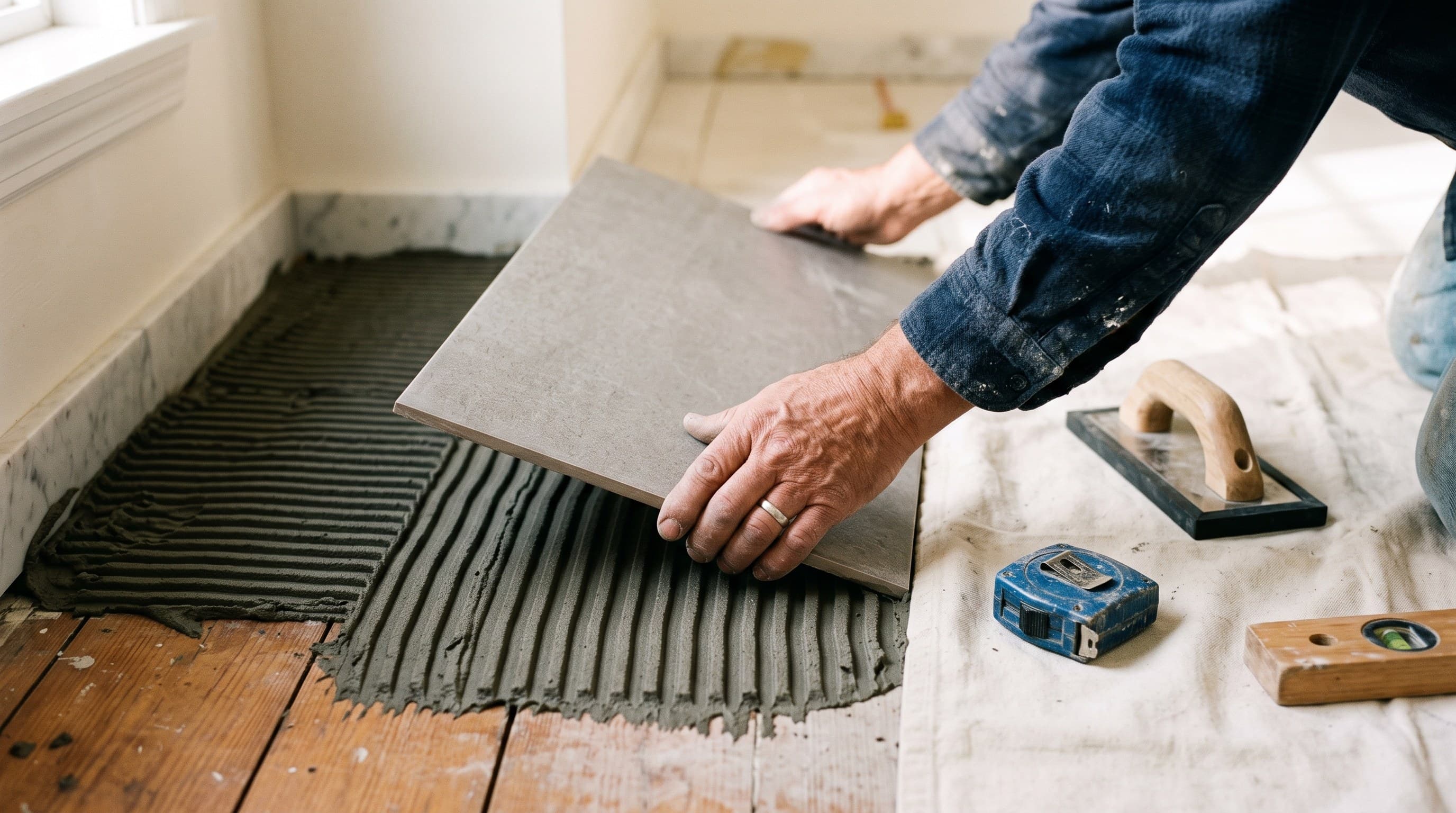
Tile installation in Monmouth and Ocean County NJ runs $10 to $35 per square foot installed in 2026, with labor alone landing at $7 to $15 per square foot and material running anywhere from a $2 builder-grade porcelain to a $25+ honed marble. That is a wide spread, and it is not arbitrary. Where you land inside it has very little to do with what city you are in or how busy the installer is this month, and almost everything to do with the pattern you picked, the substrate underneath, the wet-area waterproofing, and the prep nobody photographs. The cheap quote usually costs less by skipping the prep that costs the most. The expensive quote costs more because it includes the layer of the job that determines whether the tile is still flat in five years.
The full installed range for NJ runs roughly 24% over the national average per the 2026 trade reporting, which tracks the same labor premium you see in every other NJ trade. The number does not move much between Monmouth and Ocean County. It moves a lot between a straight-set 12x24 porcelain on a sound subfloor and a herringbone marble in a steam shower. Here is the honest breakdown of where the per-square-foot number actually goes, what raises it, and the three lines on a shore tile quote that tell you whether the installer is doing the work right or pricing the easy version of it.
What Does Tile Installation Actually Cost Per Square Foot in NJ?
In Monmouth and Ocean County NJ in 2026, expect $10 to $35 per square foot installed, broken into roughly $7 to $15 per square foot of labor plus $2 to $25 per square foot of material. Most residential bathroom and kitchen jobs land between $18 and $26 per square foot installed. A simple straight-set porcelain floor in a small mudroom comes in at the low end. A herringbone marble shower with a curbless threshold and a built-in bench lands at the high end, and a heated-floor steam shower with full-height stone walls is past it.
The single biggest cost driver is not the tile. It is the pattern and the prep. Two jobs with the same $5 per square foot tile can finish $12 per square foot apart on the install because one is straight-set with no demo and one is a 45-degree herringbone over a demoed slab with new uncoupling membrane.
What Does the Labor Portion Actually Cover?
The $7 to $15 per square foot of tile labor in NJ covers six things, in roughly this order of time on the job: substrate prep, layout, cutting, setting, grouting, and detail work. Skip any of them and the number drops by a couple of dollars per square foot. Skip the wrong one and the installation fails inside three years.
- Substrate prep. Pulling old flooring, leveling a deflecting subfloor, installing cement board or uncoupling membrane (Schluter DITRA, Ardex MC, or equivalent), and confirming the floor is flat to the tile manufacturer's spec (typically 1/8 inch in 10 feet for large-format). This is the layer that does not show in the photo and is the line item the cheap quote almost always shortcuts.
- Layout. Dry-laying the field, locating the focal point (front of the shower, sight line from the door, the niche), centering the pattern correctly, and making the cuts land in the inconspicuous corners instead of in the doorway.
- Cutting. Wet-saw cuts for the field, hole-saw work for plumbing penetrations, miters or pencil-trimmed edges on outside corners, and on a herringbone or mosaic pattern, the cut count alone can double the time.
- Setting. Mixing the right thinset for the tile and substrate (modified vs unmodified, large-format vs standard), back-buttering the heavy tiles, working in small areas so the mortar does not skin over, and back-supporting any tile over the 3/8 inch lippage line.
- Grouting. Mixing the grout consistently, working it into the joints, striking the joints at the right point in the cure, and washing with a clean float on a sponge that gets rinsed regularly so the grout haze comes off cleanly.
- Detail work. Silicone at every change of plane, edge profiles (Schluter Jolly or pencil-trim stone), trim around the niche, and the final clean.
The Tile Council of North America's labor reporting puts the NJ tile setter trade rate around $58 per hour in 2026. Inside the $7 to $15 per square foot range, you are buying roughly 10 to 20 minutes of skilled labor per square foot. A herringbone pattern in stone with a curbless entry routinely runs the high end of that. A straight-set 12x24 porcelain on a flat slab runs the low end.
What Raises the Per-Square-Foot Price the Most?
Five things move you from the middle of the range to the top of it, almost regardless of the tile itself. Worth knowing what they are before you call for quotes, because every one of them is something that should show up as a separate line item on a real estimate.
- Pattern complexity. Straight-set is the baseline. Brick offset and 45-degree diagonal add about $1 to $3 per square foot in cuts and waste. Herringbone adds $3 to $6. Chevron, basketweave, and full mosaic add $5 to $10+. The pattern is a cost decision as much as a finish decision.
- Large-format tile (24 inches and up on the long side). Anything 24x24, 24x48, or larger needs a flatter substrate (often a self-leveling pour), a larger trowel with a heavier mortar bed, back-buttering on every piece, and usually a tile-leveling system to control lippage. Add about $2 to $5 per square foot over standard-format on the same pattern.
- Demo of existing flooring. Pulling carpet and pad is cheap. Pulling old ceramic tile that was set in mortar 30 years ago is expensive. Demo and disposal on a shore bathroom runs $400 to $1,200 as a standalone line and almost always belongs as one, not buried in a per-square-foot blended rate.
- Waterproofing in a wet area. The Schluter KERDI, RedGard, or Hydro Ban membrane in a shower or steam room is a separate scope and adds about $3 to $7 per square foot to the wet-zone portion of the work. The shower we wrote about in our shore-shower niche piece would not exist without it.
- Substrate repair. A bouncy bathroom floor needs sister joists or additional blocking before any tile gets set, or the grout joints will crack inside a year. A wall that is out of plumb on a wet zone needs floating before the membrane goes on. These show up the day demo opens the floor or the wall and are the line item most prone to "we'll see when we get there."
Where Does the Money Actually Go on a Typical Shore Bathroom?
On a 60 square foot Monmouth or Ocean County master bathroom with a 35 square foot shower, the 2026 numbers look something like this. The exact split moves with the tile, but the proportions hold.
| Line item | Typical 2026 cost |
|---|---|
| Demo and disposal (existing floor + shower) | $650 – $1,400 |
| Substrate prep (cement board, uncoupling membrane, leveling) | $450 – $900 |
| Wet-area waterproofing (Schluter KERDI or liquid membrane) | $550 – $1,100 |
| Tile labor, floor (60 sq ft, straight-set porcelain) | $420 – $900 |
| Tile labor, shower walls + floor (35 sq ft, with niche + bench) | $700 – $1,750 |
| Grout, silicone, edge profiles, final clean | $220 – $480 |
| Material (tile + mortar + grout, mid-range porcelain) | $400 – $1,500 |
| Total installed | $3,390 – $8,030 |
That is for a single mid-range bathroom, roughly the same job a homeowner sees quoted at "around $4,000" or "around $8,000" with no breakdown. The breakdown is the part that tells you which one is actually pricing the work and which one is hoping you do not ask.
Why Does the Cheapest Quote Usually Cost More?
Because the line items that get cut to make the low number are the same line items that determine whether the installation fails. Three quotes for the same 60 square foot bathroom commonly come back at $3,200, $5,800, and $7,400. The middle is usually right. The low quote almost always has one or more of the following missing:
- No uncoupling membrane under the floor. Saves the installer $300 to $500. Costs the homeowner a cracked floor where the bath meets the doorway in year two, every time the slab moves a hair with seasonal humidity. The Tile Council's TCNA Handbook calls a crack-isolation layer the standard of care for tile over plywood; the cheap quote skips it.
- Liquid-applied waterproofing rolled on too thin, or no waterproofing at all behind the tile in the wet zone. Saves $400 to $800. Costs the cost of tearing the shower out when it leaks. We covered why this is the single most common shore-shower failure in our cracking-causes piece.
- No silicone at the change-of-plane seams. Saves a couple of hours. Cracks at every interior corner inside two summers because grout does not flex and tile assemblies always do.
- Underbid demo, ad-hoc upcharges later. The line item disappears from the quote and reappears as a change order with no real ceiling. By the time the floor is open, the homeowner is not in a position to renegotiate.
On a real estimate, the cheapest of the three quotes is almost never the actual cheapest job. It is the most expensive job priced as if it were the easy one. The middle quote, with the prep lines actually broken out, is almost always the real number.
How to Read a Tile Quote Like a Pro
- Is the substrate prep a separate, named line? "Install cement board with appropriate fasteners," "uncoupling membrane," "self-leveling pour." Each one is a line, with a measurable scope and a price.
- Is the wet-area waterproofing system named? "Schluter KERDI bonded membrane," "Hydro Ban liquid-applied, two coats." Not "waterproof shower." A real wet-zone scope names the product.
- Is the pattern in writing? "Straight-set" vs "herringbone" vs "1/3 offset brick" should be in the quote because they price differently. If the quote is silent, the installer can pick the cheapest one to install and you will not see it until tile is on the wall.
- Are change-of-plane seams called out for silicone? A quote that says "all change-of-plane joints sealed with color-matched silicone" is a quote written by a real wet-area installer.
- Are edge profiles specified? Schluter Jolly, pencil-trimmed stone, mitered porcelain: pick one. A finished edge that is "TBD" is a finished edge that will be whatever is cheapest.
- Is demo a separate line, with a per-square-foot or fixed price? "Demo as needed" is a blank check.
If a quote covers all six lines, the price is real. If it covers two of them and the rest is a per-square-foot blended rate, the price will be real later, the hard way.
What Does JL Tile & Stone Charge in Monmouth and Ocean County?
We quote every shore bathroom with the breakdown above, in writing, before any work starts. Our installed range lands in the middle of the 2026 NJ market, typically $18 to $26 per square foot installed for a residential bathroom or kitchen on a sound substrate, more on a herringbone or stone install, more again on a steam shower or curbless wet room. The prep is on the quote. The waterproofing system is on the quote by name. The pattern is on the quote. The number you sign is the number you pay, with the only exception being substrate repair if demo opens up a rotted subfloor. If that happens, you see the photos and approve the change order before the work starts.
If you are weighing tile quotes for a bathroom remodel in Toms River, Brick, Manasquan, Spring Lake, Sea Girt, LBI, or anywhere else in Monmouth and Ocean County, send the quotes over or call (848) 210-1946 for a walk-through. We will tell you which of the lines above are missing from each quote before you sign anything. For more on the bathroom-level numbers, see our NJ bathroom remodel cost guide and our how to hire a tile installer in NJ walk-through.