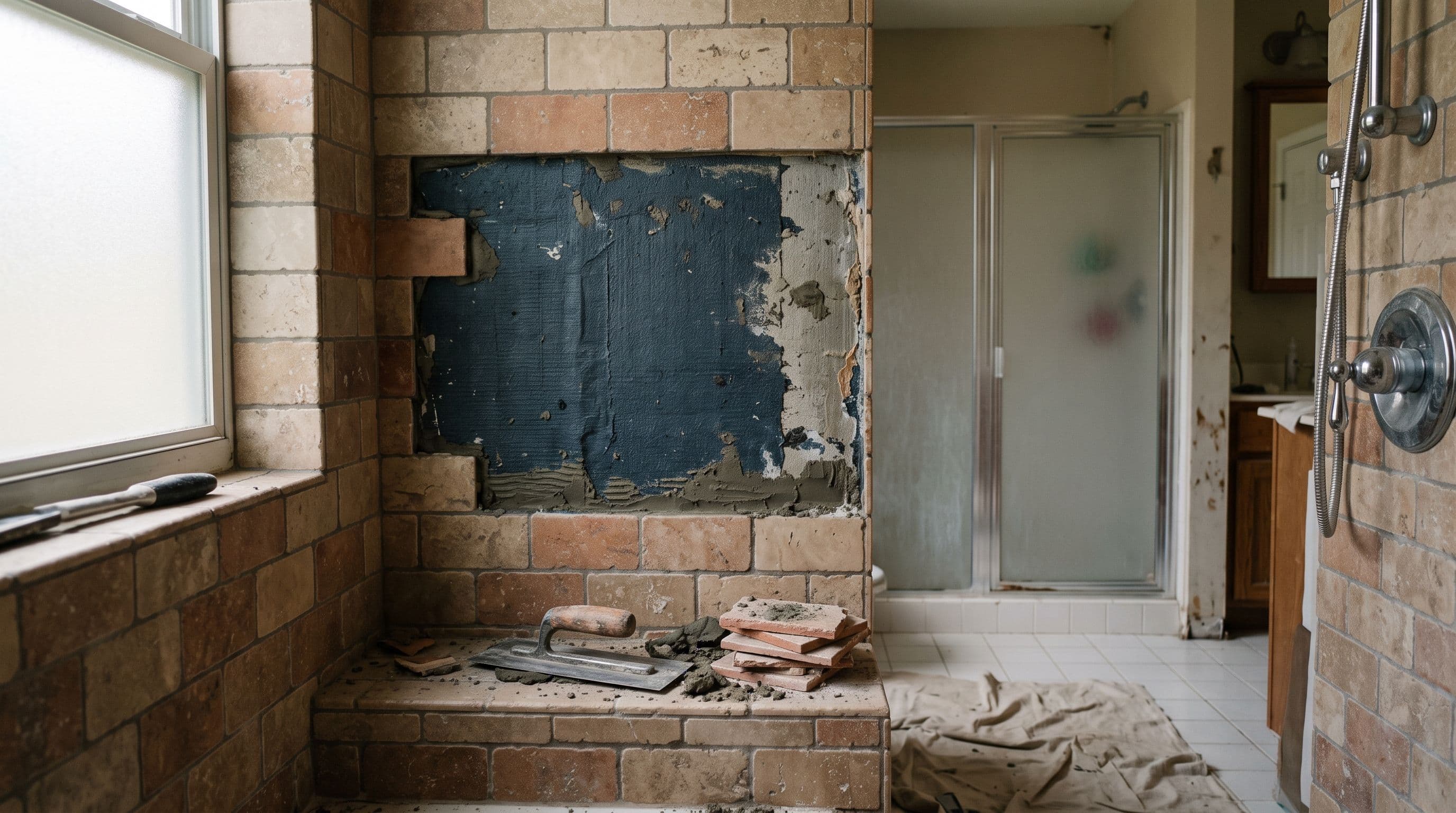
Short answer: tile repair vs a full bathroom rebuild comes down to 3 questions: how far the damage has spread, whether the substrate underneath is still sound, and whether the tile can be matched. If all three pass, repair the tile. If any one fails, you are tearing it out. Updated August 2026.
This is one of the most honest questions a homeowner in Monmouth or Ocean County can ask, and the one where the wrong answer costs the most. A cracked tile does not automatically mean a demolished bathroom, and a bathroom that looks perfect can be quietly rotting behind the wall. What decides repair versus rebuild is what sits underneath the tile, and you cannot judge that from the finished face.
Jesse has been setting and pulling tile across the Jersey Shore for over 30 years. We have torn out plenty of two-year-old showers in Toms River and Brick that a quick "just regrout it" would have papered over for six months before the wall failed. We have also talked homeowners out of a full rebuild because the actual problem was one bad tile and a sound wall behind it. Here is how a tile setter makes that call, in both directions.
What Are the Three Questions That Decide Tile Repair vs a Full Bathroom Rebuild?
Three questions decide tile repair vs a full bathroom rebuild, and you answer them in order because the first failure ends the sequence. First, how far has the damage spread: one tile, one wall, or the whole wet area? Second, is the substrate behind the tile still sound, or has water already gotten past it? Third, can the tile be matched closely enough that the repair does not read as a patch? The moment any single answer turns bad, you are no longer repairing a bathroom, you are rebuilding one. Pretending otherwise just buys a few months before you pay twice.
When Is a Spot Repair Genuinely the Right Call?
A spot repair is genuinely the right call when the damage is isolated, the tile around it is well bonded, and the substrate is dry and solid. Most often that is a single cracked floor tile, a chipped corner, or a short run of loose backsplash in a dry room. If a tile cracked from a dropped pan and the tiles around it ring solid, replacing that one tile is a two-hour job and rebuilding the room would waste your money. We say that out loud on plenty of estimates, because recommending a repair over a rebuild when the wall is honestly sound is the most persuasive thing we can do.
Good candidates for a spot repair or a targeted section repair:
- A single cracked or chipped tile from impact, with solid, well-bonded tile around it.
- A few loose backsplash or accent tiles in a dry kitchen or laundry over a sound substrate.
- Failing grout or old caulk at a change of plane, where the tile and waterproofing are still doing their job.
- A worn or cracked transition or threshold, replaceable without disturbing the field.
What Is a Hollow Section Actually Telling You About What Is Behind It?
A hollow section is telling you the tile has lost contact with whatever is behind it, and the tap test is how we read it before committing to repair or rebuild. We run a knuckle or a screwdriver handle across the field and listen: a well-bonded tile over a solid substrate rings tight and high, and a tile with a void answers with a dull, drummy knock. It is the single most useful diagnostic on the wall, and it costs nothing. One hollow tile in a dry floor can be a thinset coverage miss from the original install: annoying, but repairable. A patch of hollow tiles low in a shower wall is a different message, because in a wet area a void is usually where water has collected and started breaking the bond from behind.
We break down the full tap test in why your tile sounds hollow, but the short version is: hollow in a dry area is often a repair, and hollow in a wet area is a reason to open the wall and look, not to regrout and hope. The sound tells you where to look; it does not tell you it is safe to skip looking.
The next question is whether the substrate is already gone. It is gone when water has moved past the tile and grout and reached the backer board or framing, and it leaves signs a homeowner can spot before we open a wall. In a shower the only thing between water and your studs is the waterproofing membrane behind the tile, and when that fails, the damage does not stay where you can see it. These are the tells that a repair is no longer on the table:
- Tiles that flex or move when pressed, or a section that shifts as a unit. The board behind has softened.
- Soft or spongy drywall or trim just outside the shower, or a baseboard that crumbles at a touch.
- A musty smell that never clears, or dark staining bleeding through grout lines or the base of the wall.
- Recurring cracked grout or tile that returns within months of every repair. The movement was hidden, not fixed.
- A ceiling stain in the room below a second-floor bath. That is water that already made the full trip.
When we open a Monmouth or Ocean County shower wall and find blackened, crumbling backer board or a damp stud line, the conversation changes on the spot. The honest answer is a rebuild of the wet area down to sound framing, new waterproofing, and new tile, the kind of tear-out we scope as a full bathroom remodel and shower build rather than a patch.
Injection Repair: What Does It Actually Fix, and What Does It Only Hide?
Injection repair fixes a real problem (a hollow but otherwise sound tile that has lost its bond) and hides a dangerous one when used on a wet, failing wall to avoid a tear-out. We drill a small port at a grout joint, inject a bonding adhesive or epoxy into the void behind the drummy tile, weight it while it cures, and regrout. On a floor tile over a solid slab that missed full thinset coverage, that reglue injection method is a lasting fix, and it saves cutting out a tile you would struggle to match.
What injection cannot do is dry out a wet wall or rebuild a failed membrane. If the void is there because water is getting past the waterproofing, injecting adhesive seals the symptom and leaves the leak running behind a now-solid-sounding wall. That is the worst outcome, because it removes your one warning sign. Our rule is simple: injection is a repair tool for a bonding void in a dry, sound assembly, never a way to avoid opening a shower wall telling you it is wet. When someone offers to inject a failing shower back to solid, they are selling you time, not a fix.
Why Is Matching Tile on a Repair Harder Than It Sounds?
Matching tile on a repair is harder than it sounds because tile is a manufactured product with dye lots, discontinued lines, and a finish that ages, so a "matching" tile from a different batch or year rarely disappears into the wall. Even the same model number shifts shade between runs, and a tile that has lived on a floor for eight years has dulled in a way a brand-new one has not.
Here is how we handle the match:
- Attic stock first. If you saved leftover tile, we use it: same lot, same age, best match. Keep a box after any tile job for exactly this.
- Salvage from a hidden spot. With no attic stock, we pull a tile from an inconspicuous area, like a closet or behind an appliance, set the salvaged tile in the visible repair, and put the new not-quite-match where nobody looks.
- Honest expectations when discontinued. If the tile is off the market with no stock to pull, we tell you the repair will be visible, and that re-tiling that surface may look better than a patch that catches the eye every day.
On real jobs like the Silverton Blue Onyx walk-in shower, the Toms River master bath, and the Morganville marble bath, the tile was set as a whole, which is why a matched repair on a distinctive stone or discontinued porcelain is the hardest case to make invisible. Sometimes the honest call is to rebuild the one surface, not because the substrate failed, but because a patch on a signature tile will never look right.
How Do You Make the Call Honestly, in Both Directions?
You make the call honestly by running the same three questions every time and letting the answers decide. A good tile setter should be as willing to talk you out of a rebuild as into one. Below is the decision table we use on a walkthrough, and it points both ways on purpose.
| What we find | Repair | Tear it out and rebuild |
|---|---|---|
| Damage spread | One tile or a small isolated area in a dry room | Multiple areas, a whole wall, or anything in a shower |
| Tap test | Surrounding tile rings solid; one drummy tile in a dry area | Hollow patch low in a wet wall, or a section that moves as one |
| Substrate | Backer and framing dry and firm behind the tile | Soft board, damp studs, musty smell, or recurring cracks |
| Water history | No leak signs; damage from impact or a single event | Stains below, ongoing leak, or waterproofing has failed |
| Tile match | Attic stock or a salvageable close match exists | Discontinued signature tile with no stock to pull |
| Honest outcome | Fast, low-cost, invisible fix that lasts | Rebuild once, correctly, instead of patching twice |
A spot repair is the least expensive path by far when the assembly underneath is sound, and the most expensive of all when it postpones a rebuild the wall needs, because you pay for the repair, then the rebuild, then the rot the delay caused. Repair versus replace is not really a cost question; it is a "what is behind the tile" question, and the cost sorts itself out once that is answered.
Frequently Asked Questions
- Can you just replace one cracked tile without redoing the whole bathroom?
Yes. When the crack is from impact, the tile around it rings solid on a tap test, and the substrate is dry and firm, replacing a single tile is a routine repair and rebuilding the room would be a waste. The two things that turn a one-tile job into a bigger one are a hollow or moving substrate and a discontinued tile that cannot be matched. We check both before quoting so there are no surprises once the tile is out.
- How do I know if the damage is behind the tile or just on the surface?
Run a tap test and look for water signs. Tap the tile with a knuckle: a tight, high ring means a solid bond, and a dull, drummy sound means a void behind it. Then look for soft drywall near a shower, a musty smell, dark staining in grout lines, or grout that keeps cracking in the same spot. Surface-only damage is a repair; a hollow wet wall or any sign water reached the framing means the problem is behind the tile.
- Is injecting adhesive behind loose tile a real fix or a shortcut?
A real fix for the right problem, a dangerous shortcut for the wrong one. On a dry, sound floor or wall where a tile lost its bond from a thinset coverage miss, injecting a bonding adhesive and regrouting is a lasting repair. On a failing shower wall where the void exists because water is getting past the waterproofing, injection just seals the symptom and hides an active leak. We only inject a wall we have confirmed is dry and sound.
- Why does repaired grout or tile keep cracking in the same place?
Because the crack is a symptom of movement or moisture underneath that the repair never addressed. Grout and tile are rigid; they crack when the substrate below flexes, when a floor deflects more than tile can tolerate, or when water has softened the board behind them. Replacing the surface without fixing the movement or leak just resets the clock. Recurring cracks in the same spot are one of the clearest signs the real answer is a rebuild of that section, not another patch.
- What if the tile is discontinued and can't be matched?
If the tile is off the market and you have no attic stock, an exact match usually is not possible, and we will tell you that straight. The options are to salvage a tile from a hidden spot, such as a closet or behind an appliance, for the visible repair, or to re-tile the whole surface so the finish is uniform. On a plain tile a close match is often fine; on a distinctive stone, a patch catches the eye every day, and re-tiling that one surface is frequently the better-looking call even when the substrate is sound.
- Do you serve my area for tile repair in Monmouth and Ocean County?
Yes. JL Tile & Stone serves Monmouth and Ocean County, NJ only, from Red Bank and Freehold down through Toms River, Brick, and Point Pleasant. We handle both ends of this decision, a fast single-tile repair and a full wet-area rebuild, and give you an honest read on which one your bathroom needs before any work is scheduled.
Read What Is Behind the Tile First
Repair the tile or tear it out? Run the three questions: how far the damage has spread, whether the substrate behind the tile is still sound, and whether the tile can be matched. If all three pass, a targeted repair is the honest, low-cost answer, and anyone pushing a full rebuild on a sound wall is overselling you. If the tap test finds a hollow wet wall, soft board, or failed waterproofing, no patch will hold, and rebuilding the wet area once is far cheaper than patching it twice and repairing the rot in between. The only way to know for sure is to read what is behind the tile, not just what you can see. If you want that honest read on a bathroom in Monmouth or Ocean County, call or text JL Tile & Stone at (848) 210-1946, or book a free in-home assessment. For the full scope of either path, see our tile installation service and our bathroom remodel and shower build service. Serving Monmouth and Ocean County only, from Toms River and Brick up through Red Bank.