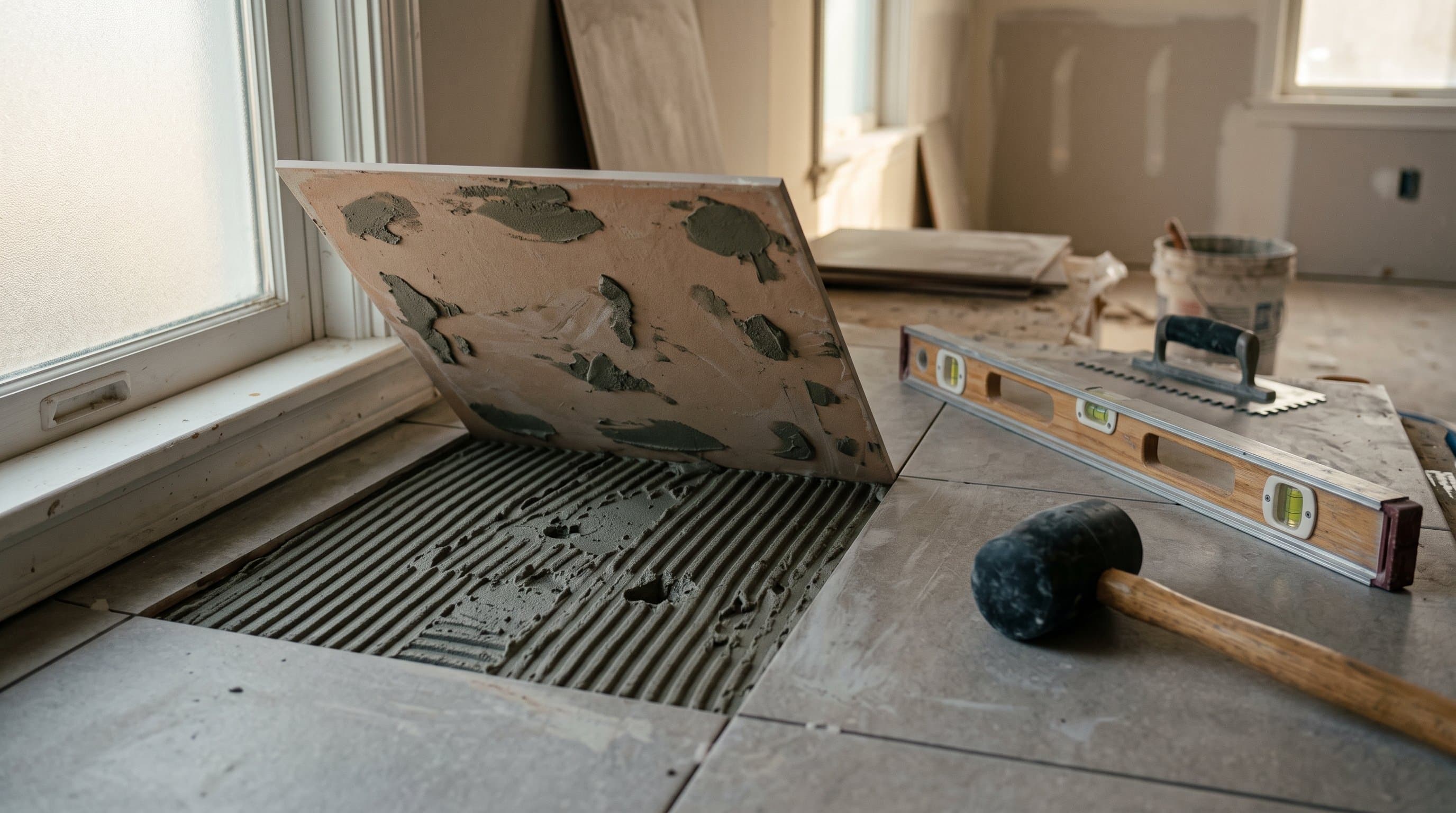
Short answer: hollow sounding tile means air under the tile instead of solid mortar, and the pattern tells you whether that is a defect. Isolated hollow tiles point to a bonding void, since ANSI A108 requires 80% coverage in dry areas and 95% in wet. A whole floor sounding hollow is usually an uncoupling membrane working as designed. Updated July 2026.
Homeowners in Monmouth and Ocean County ask us about this all the time. You tap a tile with a knuckle or a coin, and instead of a solid tick it answers with a low, drummy, hollow sound, while the tile next to it sounds dense and dead. That difference is real, and it is telling you something about the layer you cannot see under the tile.
Here is the honest breakdown from a tile setter who has torn out plenty of hollow floors: what the sound means, when it matters, when it does not, and the one number that decides whether a tile was set right. Jesse has been setting tile across the Jersey Shore for over 30 years, and this is exactly what we check on every job before we call it done.
What Does It Mean When Tile Sounds Hollow?
A hollow sound means there is an air gap between the tile and the substrate underneath it, where the mortar failed to fully bond the two together. Tile that is fully embedded in a solid bed of mortar rings dense and quiet because the sound has nowhere to echo. Tile with a void underneath acts like a tiny drum: the air pocket vibrates and gives you that low, resonant thud. So the sound itself is not the problem. It is a symptom that points to how the tile was set, or to a bond that has started to let go over time.
There are two versions of this. The first is a tile that has sounded hollow since day one because it was never bonded correctly. The second is a tile that used to sound solid and now sounds hollow, meaning the bond has failed or the substrate has moved. Telling those apart is most of the work, and it is why a tap test is worth doing before you panic or pry tiles up.
Is a Hollow Sounding Tile Always a Problem?
No, a hollow sounding tile is not always a problem, and this is the part most scare-articles skip. A single tile that sounds slightly hollow, sits flush with its neighbors, has tight intact grout, and does not flex or move under weight is often fine to leave alone. Small voids happen even on good installs, especially at the edges of a tile or over a slightly uneven substrate, and they do not always mean failure.
What turns a hollow tile from a cosmetic curiosity into a real problem is when the hollow sound shows up alongside other warning signs. Watch for these:
- Grout lines that are cracking, crumbling, or powdering around the hollow tile.
- A tile that visibly moves, rocks, or flexes when you step on it or press hard.
- A tile sitting higher or lower (lippage) than the tiles around it.
- Several hollow tiles clustered in the same area, especially in a walkway or a wet zone.
- A hollow tile in a shower floor, shower wall, or any spot that gets soaked regularly.
- A tile that used to sound solid and has recently gone hollow.
One quiet hollow tile on a dry entry floor is a shrug. A cluster of hollow tiles with cracking grout in a shower is a warning that the bond is failing and water is getting a path in. The context around the sound is what matters, not the sound by itself.
A hollow sound can even be normal by design. Some floors are built to sound hollow, and the giveaway is consistency. Two common assemblies ring hollow on purpose across the entire field, and neither one is a defect:
- Uncoupling membranes. An orange dimpled sheet like Schluter DITRA sits between the tile and the subfloor with an air-and-mortar layer in every dimple. That layer is exactly what lets the tile and the subfloor move independently so the tile does not crack, and it makes the finished floor sound hollow everywhere. That is the membrane doing its job.
- Mortar-bed and mud-set assemblies. Older and high-end installs float the tile on a thick mortar bed, sometimes over a cleavage membrane. The system is dense and durable, and it also reads hollow to a tap because of the layered build underneath.
The tell is uniformity. If nearly every tile in the room answers the same hollow note, the floor almost certainly sits on one of these assemblies and there is no bonding problem to chase. Hollow by design is even, edge to edge, and it does not come with cracked grout or moving tiles. When someone taps a DITRA floor and panics, they are hearing engineering, not failure. A bonding void is the opposite: isolated, inconsistent, and usually surrounded by the warning signs above.
How Do You Do a Tap Test on Tile?
You do a tap test by lightly tapping across every tile with a hard object and listening for the tiles that answer hollow instead of solid. It costs nothing, takes ten minutes, and it is the same first check a professional runs. Here is the sequence we use on a walkthrough:
- Grab a hard, small tool: a metal coin, the butt of a screwdriver, a golf ball, or a knuckle on harder tile. Keep it consistent so your comparison is fair.
- Tap the center of each tile and then near each corner, working in a grid so you do not skip any.
- Listen for the difference. Solid tiles ring high, tight, and dead. Hollow tiles answer low, drummy, and resonant.
- Mark the hollow tiles with a bit of painter's tape so you can see the pattern once you are done.
- Step back and read the map. Isolated singles are usually minor. Clusters, wet-area hits, and lines of hollow tiles are the ones to act on.
- Press and rock any hollow tile with your hand or foot. Movement plus hollow sound is the combination that means the bond is genuinely failing.
The tap test tells you where the voids are. It does not tell you why they are there, and that is where the cause matters.
What Causes Hollow Sounding Tile?
Hollow sounding tile is almost always caused by poor mortar coverage during installation, which is a workmanship issue, not a material defect. The tile did not get pressed into a full bed of thinset, so air was left trapped underneath. The specific ways that happens, roughly in order:
- Skipping back-buttering on large-format tile. Big tiles need thinset troweled onto the back of the tile as well as the floor. Skip it and the center never makes contact.
- Wrong trowel size. Too small a trowel lays down too little mortar to fill the gap, especially under a tile that is not perfectly flat.
- Not flattening the trowel ridges. Combed ridges of thinset that never get collapsed leave air channels between the peaks.
- Thinset that skinned over before the tile went down. If the mortar starts to dry (skins over) before the tile is set, it will not grab, and you get a weak, hollow bond.
- An uneven or unprepared substrate. A wavy floor or an unflattened subfloor leaves gaps the setter tried to bridge instead of fixing first.
- Substrate movement over time. A flexing subfloor, a slab crack, or an underlayment that was never right can break a good bond months or years later.
Notice the theme: almost every cause traces back to prep and coverage, the work that happens before and during the set. That is why we say tile problems are usually installer problems. A hollow floor rarely means you bought bad tile. It usually means the tile was never fully bonded. If yours is cracking too, the root cause often overlaps, which we cover in why your shower tile is cracking.
Coverage is where the standard comes in. ANSI A108 sets the minimum mortar coverage for a proper tile install, and it is the number that separates a hollow floor from a solid one: at least 80% coverage in dry interior areas, and at least 95% coverage in wet areas and exterior installations, with no large gaps in the corners. That is the standard, in writing, that a good installer builds to. A tile that sounds hollow is very often a tile that came in under that coverage threshold because someone skipped back-buttering or ran the wrong trowel. Here is what that looks like in plain terms.
| Area | ANSI A108 minimum coverage | Why the standard is set there |
|---|---|---|
| Dry interior (entry, living area, dry wall) | At least 80% | Supports foot traffic and prevents cracking; small voids tolerated |
| Wet areas (showers, tub surrounds, floors that get soaked) | At least 95% | A void is a place water sits, which feeds bond failure and mold |
| Exterior (patios, pool decks, outdoor kitchens) | At least 95% | Freeze-thaw water expanding in a void pops the tile loose |
| Large-format tile (any tile 15 inches or larger on a side) | Back-butter required to hit coverage | Big tiles will not seat fully on troweled floor mortar alone |
The wet-area number is the one homeowners should care about most. A hollow tile in a dry entry is usually cosmetic. A hollow tile in a shower has failed the 95% standard, and now there is an air pocket in the wettest part of the house where water can pool, sit, and work on the bond and the substrate behind it. That is how a hollow shower tile becomes a rotted wall two years later.
Do You Have to Replace a Hollow Sounding Tile?
Not always, and a good installer will not sell you a full tear-out over one hollow tile. The decision comes down to where the tile is, whether it moves, and whether the grout around it is still holding. A stable, isolated hollow tile on a dry floor with tight grout can usually be left alone and monitored. A hollow tile that moves, has cracking grout, or sits in a wet or high-traffic area should be addressed before the failure spreads.
When a repair is warranted, the honest options run from least to most invasive. A stable void under an otherwise solid tile can sometimes be stabilized with an epoxy injection through a grout joint. A single failed tile can be cut out and reset without disturbing the field. A cluster of hollow, moving tiles in a wet area usually means the section has to come out and be reset over a properly prepped, waterproofed substrate, because the real problem is coverage or a substrate issue a patch will not fix. If you are weighing a patch against a bigger job, our guide on whether to repair the tile or tear it out walks through the exact call. Which one is right depends on the tap-test map and what is under the tile.
How Does JL Tile & Stone Prevent Hollow Tile?
We prevent hollow tile by building every install to beat the ANSI coverage standard, not just meet it: full mortar coverage on every tile, back-buttering on all large-format work, and a flattened, properly prepped substrate before a single tile goes down. Jesse's process is the same on a Toms River bathroom floor as it is on a Rumson master suite, because full coverage is not an upgrade, it is the job done right. The steps that keep a floor solid:
- Flatten and prep the substrate first, because a wavy floor guarantees voids no matter how good the setter is.
- Match the trowel to the tile size so there is enough mortar to fully fill the gap.
- Back-butter large-format tile so the center bonds, not just the edges.
- Collapse the trowel ridges by setting and beating in each tile so the mortar peaks flatten into a full bed with no air channels.
- Pull and check a tile early in the install to confirm coverage on the back before committing the whole floor.
- Tap-test the finished field ourselves before we grout, so any hollow tile gets reset while it is still easy.
That last step is the one cheap crews skip. We would rather find a hollow tile before grout day than have you find it a year later. For the full scope of how we handle a floor or a full remodel, see our tile installation service and our bathroom remodel and shower build service.
Frequently Asked Questions
- Does hollow sounding tile always mean it will crack or pop off?
No. Hollow sounding tile means there is a void under the tile, but a stable void under a well-supported tile can last for years without cracking. The risk goes up when the tile moves, when the grout is failing, or when the tile is in a wet or high-traffic area. A hollow tile that flexes underfoot is the one likely to crack. A quiet, stable hollow tile on a dry floor often never gives you a problem.
- How can I tell if a hollow tile is serious?
Check three things. Does the tile move or rock when you press it? Is the grout around it cracking or crumbling? Is the tile in a shower, a floor that gets wet, or a busy walkway? A yes to any of those makes it worth addressing. A stable, isolated hollow tile on a dry floor with intact grout is usually fine to monitor rather than repair.
- What is the tap test for tile?
The tap test is lightly tapping each tile with a coin, a screwdriver handle, or a knuckle and listening for the tiles that sound low and drummy instead of high and solid. The hollow ones have a void underneath. It is the same quick check a professional runs first, and it costs nothing to do yourself before you call anyone.
- Why does new tile sound hollow right after installation?
New tile that sounds hollow was almost certainly not set with full mortar coverage. Common causes are skipping back-buttering on large-format tile, using too small a trowel, or setting the tile after the thinset had already skinned over. ANSI A108 requires at least 80% coverage in dry areas and 95% in wet areas, and a fresh hollow tile usually means that standard was missed during the install.
- Can a hollow tile be fixed without ripping out the whole floor?
Often, yes. A stable void can sometimes be stabilized with an epoxy injection through a grout joint, and a single failed tile can be cut out and reset without touching the rest of the field. A full tear-out is only necessary when a cluster of hollow tiles is moving, especially in a wet area, because that points to a coverage or substrate problem a spot repair will not solve.
- Is a hollow tile in a shower more serious than one on a floor?
Yes. A hollow tile in a shower is more serious because a shower is the wettest surface in the house and ANSI requires 95% coverage there for a reason. The void becomes a spot where water can sit and work on the bond and the substrate behind the tile. A hollow shower tile is worth addressing sooner than a hollow tile on a dry floor.
Tap It, Then Read the Grout and the Location
Hollow sounding tile is a bonding void, and the sound is the tile telling you the mortar under it never made full contact. Sometimes that is harmless, and sometimes it is the first sign of a failure that will cost you a wall, especially in a shower. The way to know is a simple tap test plus an honest look at the grout, the movement, and where the tile lives. If you have hollow tiles in a bathroom, kitchen, or floor in Monmouth or Ocean County and want a straight answer on whether it needs a fix, call or text JL Tile & Stone at (848) 210-1946, or request a free tile inspection and quote. We will tap-test the space, tell you what is going on under the tile, and give you an honest number, whether that is a single reset or nothing at all. Serving Monmouth and Ocean County only, from Toms River and Brick up through Red Bank and Rumson.