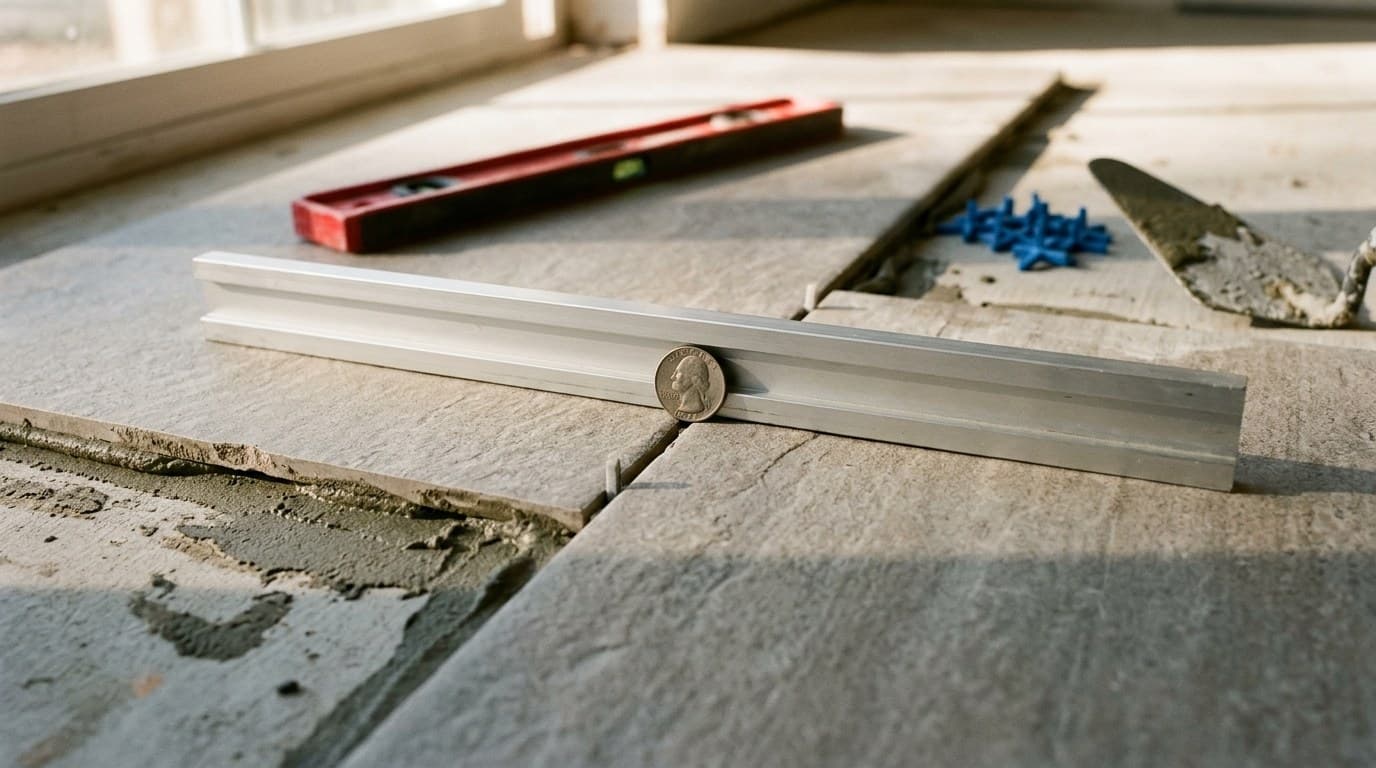
Short answer: under ANSI A108.02, acceptable tile lippage is 1/32 inch plus the tile's own warpage when your grout joints are narrower than 1/4 inch, and 1/16 inch plus warpage once the joints are 1/4 inch or wider. That is the whole spec. Lippage is the little step you feel where one tile edge sits higher than its neighbor, and the industry gives it a measurable ceiling instead of leaving it to taste. We have watched homeowners hold back a final payment over a floor that was actually inside tolerance. We have also seen installers wave off a floor that was well past it. Both sides were guessing. Updated September 2026.
Lippage Is a Measurement, Not an Opinion
Lippage is the height difference between the edges of two tiles that sit next to each other. You feel it with a bare foot or a fingertip before you ever see it. The reason it turns into a fight is that both sides are usually describing a feeling, and a feeling has no ceiling. The standard fixes that. ANSI A108.02 is the American National Standard that installers, inspectors, and manufacturers all point to, and it puts a hard number on how much step is allowed. Once there is a number, the conversation changes from "this looks bad" to "measure it." We have sat at kitchen tables where a 119-comment argument from an online tile forum was open on a phone, everyone certain, nobody holding a straightedge. The spec ends that. It does not care how the floor looks in raking light. It cares how tall the step is and how wide the joint is.
The Allowance Moves With Tile Size and Joint Width
The thing most people miss is that the allowance is not one fixed number. It depends on your grout joint. For joints narrower than 1/4 inch, ANSI A108.02 allows 1/32 inch of lippage plus the inherent warpage of the tile. For joints 1/4 inch and wider, it allows 1/16 inch plus warpage. That word warpage carries weight, because every tile leaves the factory with a slight bow that is legal under ANSI A137.1, the manufacturing standard, and that bow ranges from about 1/32 inch to 3/32 inch depending on the tile. So a floor with a tight 1/8 inch joint gets a smaller allowed step than a floor with a wide 3/8 inch joint, on purpose. Tight joints show every flaw. A wider joint hides a little and earns a little more room in the spec. If someone quotes you "1/16 inch, always," they are half right and half wrong.
How to Measure Lippage Yourself With a Straightedge and a Card
You do not need a lab. Lay a rigid straightedge, a level or a clean piece of angle iron, across two tiles so it bridges the joint. Set it down flat and look at the high tile. Now try to slide something of a known thickness under the low side. A standard plastic card, a credit card or a license, runs right around 1/32 inch thick. If a single card slips under the low edge on a floor with joints below 1/4 inch, you are near the limit. Two cards stacked and you are almost certainly past it. A feeler gauge does the same job with an exact reading if you own one. Check several joints, not one. A whole floor is judged on whether it holds tolerance across the field, and one proud corner tile is a different problem than a floor that steps everywhere. Getting this right across a whole room is the real work of a tile installation, and it starts long before the first tile is buttered.
The Floor Under the Tile Decides Most of This
Most lippage is not a tile problem or even a bad hand. It is the floor under the tile. Thinset can bridge a small dip, but it cannot flatten a subfloor that rolls, and a tile is a rigid plane laid over whatever it is stuck to. The TCNA Handbook, the companion to the ANSI standards, calls for the substrate to be flat within 1/4 inch in 10 feet for most tile. That is the baseline. If the floor waves more than that, the tile telegraphs it, and every hump becomes a lippage line at the joints. This is why prep is the real job on every floor tile we set. On our own floors, JL Tile & Stone laser-checks the subfloor and brings it flat to 1/8 inch over 10 feet with a self-leveling pour before a single tile is set, because that is the only honest way to promise a flat finish. You cannot grout your way out of a bad slab.
Large-Format Tile and the Flatness It Demands
Big tile is where flatness stops being optional. A 24 by 48 inch porcelain plank, or anything with an edge over 15 inches, has no give in it. A short tile can ride over a tiny bump and spread the error across a small face. A long tile lands on the two high points of a wave and leaves the middle floating, so the ends stand proud as lippage against the next plank. For tile that size the TCNA Handbook tightens the substrate requirement to 1/8 inch in 10 feet, and the layout matters too. Running a large-format tile in a tight brick pattern, where each tile centers on the neighbor's high bow, stacks warpage against you. We hold the offset under a third of the tile length on big planks for that exact reason. Flatter floor, smaller offset, wider joint. Those three levers are how you keep a 48 inch tile inside the same spec a 6 inch tile lives in.
What Can Be Fixed After the Fact and What Cannot
Here is the hard part, and we would rather say it before the grout than after. Some lippage can be corrected once the tile is down, and some cannot without a tear-out. A single tile that sits a hair proud can sometimes be ground and polished flush on a stone or a through-body porcelain, though it dulls a glazed tile and leaves a scar. That trick works on one tile, never a field. If the whole floor steps because the substrate was never flattened, there is no sanding your way to tolerance. The tile comes up, the floor gets prepped, and it gets reset. That is why the money and the argument both belong at the prep stage, before anything is bonded. A drummy tile next to the lippage usually means the bond failed too, and a tile that keeps cracking in the same spot is telling you the same thing. Either one is a reset no matter what the step measures.
How to Raise It With an Installer Without Starting a Fight
If a finished floor bothers you, the move is to measure, not to accuse. Put a straightedge down, slide a card, and check several joints so you are describing the field and not one tile. Then say the number and the joint width out loud together, because the spec only makes sense as a pair. "I am reading two cards under this edge on a 1/8 inch joint" is a sentence an honest installer can act on. "This looks wavy" is a sentence that starts a standoff. A good tile setter wants the number, because the number protects him as often as it protects you. Some floors that feel rough are dead inside tolerance, and a fair installer will show you that with the same straightedge. Hold the final payment for a real, measured defect. Do not hold it hostage to a feeling, and do not let anyone tell you a clean 1/16 inch step on a tight joint is simply how tile goes.
Frequently Asked Questions
- What is the acceptable tile lippage under ANSI A108.02?
For grout joints narrower than 1/4 inch, the allowance is 1/32 inch plus the tile's inherent warpage. For joints 1/4 inch and wider, it is 1/16 inch plus warpage. Warpage is set by ANSI A137.1 and runs roughly 1/32 to 3/32 inch depending on the tile, so most floors land near 1/16 inch of total allowable step.
- Is a tile installation acceptable if you can feel the edges?
Feeling an edge is not proof of a defect. You have to measure it. Bridge two tiles with a straightedge and check the step against the joint width. A step under 1/32 inch on a joint below 1/4 inch is inside the standard even if your foot notices it.
- How flat does the subfloor need to be for tile?
The TCNA Handbook calls for 1/4 inch in 10 feet for most tile and 1/8 inch in 10 feet for large-format tile over 15 inches. Substrate flatness is where most lippage is won or lost, so it is worth checking before any tile goes down.
- Can lippage be fixed after the tile is installed?
Sometimes. A single proud tile can occasionally be ground flush on stone or through-body porcelain. A whole floor that steps because the substrate was never leveled has to be taken up and reset. That is the reason flattening the floor first is cheaper than any repair.
- Do you check tile flatness on jobs in my area?
Yes. JL Tile & Stone preps and sets tile across Monmouth and Ocean County, and we will put a straightedge on a floor you are worried about and tell you honestly whether it is inside tolerance before you spend a dollar. Send a few photos or book a look through our contact page.