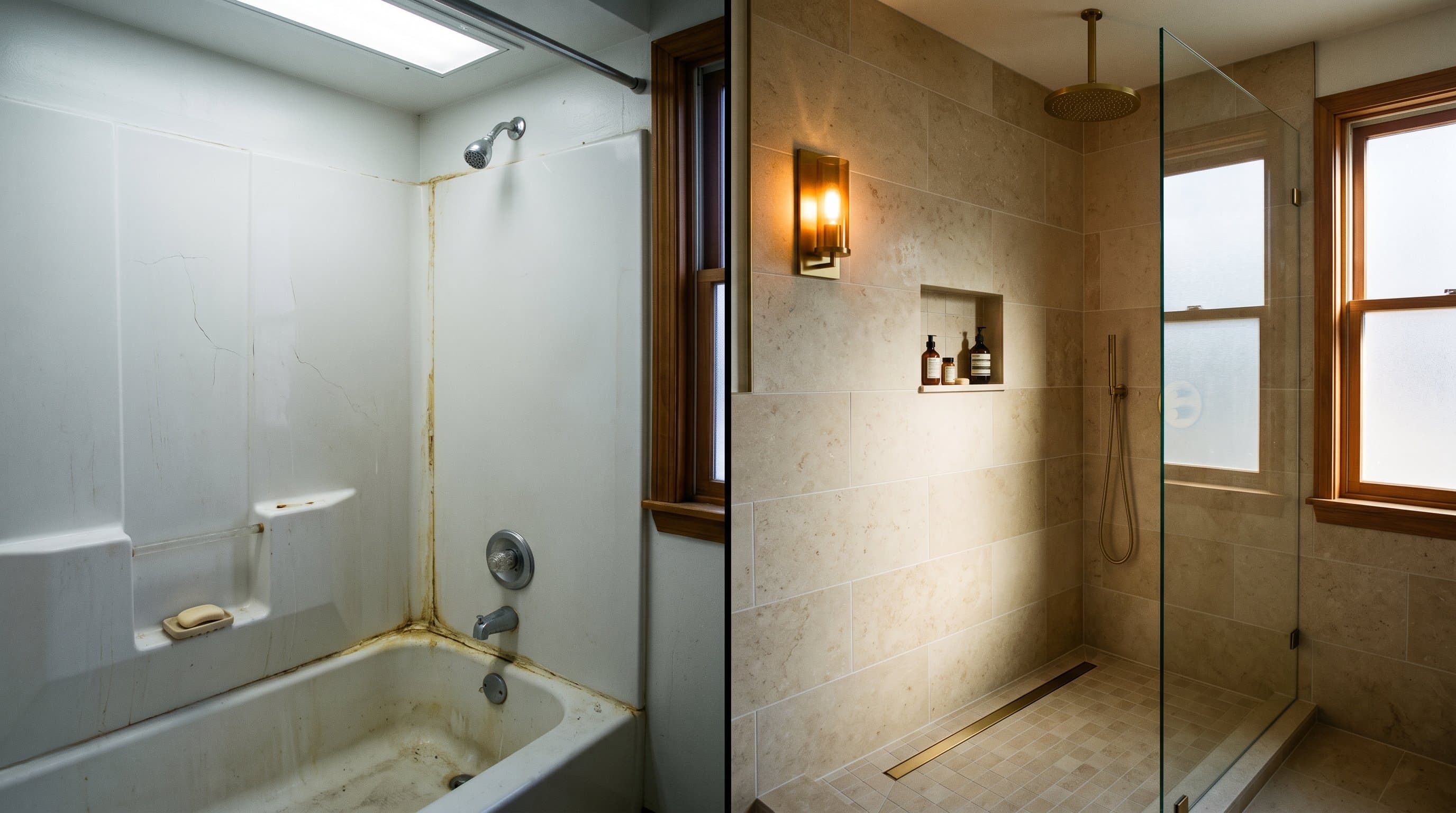
Short answer: a properly built tile shower runs $4,500 to $12,000+ installed on a Monmouth or Ocean County bathroom in 2026 and lasts 25 to 30 years; an acrylic surround runs $700 to $5,000 installed and averages 8 to 12 years on a Shore bathroom before it yellows, cracks, or gets torn out. Updated July 2026.
Every spring in Point Pleasant, Bay Head, Sea Girt, and Belmar we get the same call. Homeowner is standing in a bathroom, looking at either a hairline crack running down an acrylic corner or grout that has started walking away from the tile, and they want to know what to put back in its place. The big-box sales floor tells them acrylic. The showroom in Red Bank tells them tile. Both are half-right, both are selling from one side of the decision. Here is the honest breakdown of what each one costs on the Shore, what each one lasts, and the case where the cheaper choice is the smart one.
Tile Shower vs Acrylic Surround: What's the Real Trade?
The real trade is upfront cost versus expected life, and everything else (resale, maintenance, water-tightness) falls out of those two numbers. Acrylic is cheaper and faster to install. A properly built tile shower costs more and outlasts the acrylic by roughly two-and-a-half to one on a Shore bathroom. Selling inside seven years and the buyer won't pay for tile? Acrylic pencils out. Still in the house in fifteen? Tile pencils out before the acrylic gets replaced once.
Anchor on two numbers. First: install range. An acrylic three-piece surround with a fiberglass base runs about $700 to $5,000 installed in Monmouth or Ocean County in 2026, with the top of the range for a solid-surface unit like a Sterling Accord or a mid-tier Onyx panel with a curbless base. A custom tile shower runs about $4,500 to $12,000+ installed on the same bathroom, depending on size, tile, and whether the entry is curbed or curbless. Second: expected life at the Shore. Acrylic averages 8 to 12 years on a coastal bathroom before the surface hazes, the corner seam cracks, or the caulk fails and the wall behind rots. A tile shower built the way we build them (Kerdi bonded-membrane over the cement board, mortar or pre-sloped Kerdi pan, mitered curbless threshold, silicone at every change of plane) lasts 25 to 30 years on annual silicone refreshes alone.
Cost-per-year, it is not close on paper. A $2,800 acrylic surround at 10 years is $280/year. An $8,500 tile shower at 27 years is $315/year. Roughly the same annualized number, but the tile shower is the one an appraiser writes up on the comp sheet and the one that never leaks into the framing.
What Does Each Actually Cost in Monmouth and Ocean County in 2026?
On a standard 32 x 60 shore-bathroom shower opening, here is what the two paths actually price out to in 2026, broken out honestly. The labor gap is the whole story. Acrylic is a two-day install, tile is a five-to-eight-day install with real waterproofing and cure time between coats.
| Line item | Acrylic surround (installed) | Tile shower (installed) |
|---|---|---|
| Material | $300 – $2,200 (three-piece surround + base) | $800 – $3,500 (tile, mortar, grout, membrane, drain) |
| Demo of existing shower | $300 – $700 | $300 – $700 |
| Waterproofing / substrate | Built into panel, $0 separate | $550 – $1,400 (Kerdi membrane + backer) |
| Install labor | $400 – $1,600 (1–2 days) | $2,400 – $5,800 (5–8 days) |
| Niche, bench, curbless entry | Not offered | +$300 – $1,200 add |
| Total installed | $700 – $5,000 | $4,500 – $12,000+ |
| Realistic install time | 1–2 working days | 5–8 working days |
| Expected life on Shore bathroom | 8–12 years | 25–30 years |
The labor gap is not padding. A tile shower has four days of prep and waterproofing before a single tile gets set: demo, cement board, seam-taping the membrane, corner reinforcements, flashing the drain, curing between coats. An acrylic surround skips all of it because the panel is the waterproofing. That is the honest reason the numbers are what they are. If you want the full per-square-foot picture on tile labor, we walked through it in our 2026 NJ tile installation cost breakdown.
How Long Does Each Last on a Shore Bathroom?
A Shore bathroom is a punishing environment for both, but they fail differently. Acrylic fails at the seams and the surface. Tile fails at the waterproofing, if the installer skipped it, and lasts basically forever if they did not.
Acrylic on the Shore: 8 to 12 years average. The failure modes we tear out are consistent. The surface yellows from UV bleed through a bathroom skylight or window, especially on rental properties in Point Pleasant or Belmar where the sun hits the same wall every afternoon for six months. The corner seam cracks where two vertical panels meet, because the panels expand at a different rate than the framing behind them and the caulk seam is the sacrificial layer. The base flexes on a fiberglass pan set over a lumpy subfloor and eventually cracks the gel-coat. The caulk perimeter fails at year five to seven, and if the homeowner does not re-caulk it, water gets behind the panel and rots the framing while the front still looks fine. Salt-laden coastal humidity and freeze-thaw at unheated seasonal homes accelerate all four. Average shore rental acrylic replaces inside 12 years. A well-kept year-round primary bath might squeeze 15 to 18 on a mid-tier unit.
Tile on the Shore: 25 to 30 years done right, 3 to 7 years done wrong. The gap is install quality, not tile quality. Built with a bonded sheet membrane (Schluter Kerdi is the one we install most), a pan waterproofed continuously with the wall membrane, corner reinforcements at every inside corner, a flashed drain bonded to the membrane, and silicone at every change of plane, a tile shower outlasts the roof. Built with cement board alone, no membrane, mastic instead of thinset, and grout in the change-of-plane seams, it starts failing at year three and is gone by year seven. We walked through the specific failure modes in our how long does a tile shower last piece and the early surface signs in our why shower tile cracks guide. If the installer cannot name their membrane system in the quote, the shower is on a five-year clock, not a thirty-year one.
What's the Maintenance Reality?
Acrylic is genuinely low-maintenance for the years it looks new. Wipe-clean walls, no grout, no sealer, no annual re-caulk on the field seams. That is the honest selling point. The catch is that the caulk perimeter at the base and the corner seams still need refreshing every 12 to 24 months, and when the panel surface eventually hazes, no cleaner brings it back. The "wipe-clean forever" pitch is only accurate for the first half of the panel's life.
Tile needs annual silicone maintenance and a grout re-seal every 2 to 3 years. That means a bead of matching silicone pulled and re-run at the floor-to-wall corners, the bench-to-wall corner if there is one, and the niche-bottom seam once a year. Standard cement grout gets a penetrating sealer coat every two to three years. Skip either and the water finds its way in. Grout is porous, silicone is sacrificial, and both are meant to be maintained. Epoxy grout skips the re-seal step but costs more up front. On a Shore bathroom that sits closed October through April, we cut the maintenance interval in half: seasonal expansion and contraction is harder on the seams than year-round occupancy. We covered the shore-specific spring maintenance walkthrough in our tile shower longevity guide.
Real tradeoff: acrylic is easier for the years it works, and a total loss for the years after that. Tile asks for an hour a year and rewards it with three decades of service. Either one can look great at year two; only one still looks great at year twenty.
What Does an Appraiser Actually See on Resale?
Tile is an upgrade. Acrylic is builder-grade or below. Every appraiser and every real estate agent working Monmouth or Ocean County will tell you the same thing, and the comps back it up. On a mid-market Shore home in Spring Lake, Sea Girt, Manasquan, or Bay Head, a builder-grade acrylic surround gets noted as "original" or "dated" on the walk-through, and it caps the primary bath's contribution to the appraised value. A properly built custom tile shower, especially with a curbless entry, a stone or large-format porcelain wall, a wall niche, and a linear or brass drain, gets called out as a feature and lifts the primary bath's contribution meaningfully.
The 2026 Cost vs. Value report tracks this year after year: mid-range and upscale bathroom remodels that include tile shower work recover 60 to 70 percent of cost at resale in the Northeast, and full acrylic-surround swaps do not show up in the report at all because they are treated as maintenance, not remodel value. On a rental, the calculus flips. If the house rents by the week in Lavallette or Ocean Grove and the shower is a functional need not a design feature, acrylic is what the market pays for. On a primary residence or a long-term second home in Rumson, Deal, Sea Girt, or Bay Head, tile is the choice that shows back up on the sale sheet.
When Does Acrylic Actually Make Sense (and When Does Tile)?
Both have a lane. Neither is universally right. Here is the honest split we give homeowners over the phone before we walk the space.
Acrylic makes sense when:
- You are flipping a house in under two years and the buyer's inspection just needs the shower to work.
- The shower is in a summer rental in Lavallette, Ocean Grove, or Point Pleasant that gets seasonal use and turns over. Spend the money on the kitchen, not the bathroom.
- It is a secondary or guest bathroom that sees light use and is not visible to buyers on a resale walk-through.
- Total budget is under $3,500 and there is no room to stretch. A well-installed mid-tier acrylic on a properly leveled base is a better outcome than a bad tile shower done cheap.
- You need the bathroom back in service in a weekend and you cannot accept an eight-day out-of-service window.
Tile makes sense when:
- The bathroom is a primary or master bath in a home you plan to hold for five-plus years.
- Resale value matters, because this is a Rumson, Deal, Sea Girt, Bay Head, or Spring Lake home where the primary bath is on the tour.
- You want a curbless entry, a wall niche, a bench, or any built-in feature acrylic does not offer.
- The existing shower has already leaked once and the framing behind it needs to be replaced anyway. The demo is already sunk cost, so upgrade the finish.
- You care what it looks like at year fifteen. Only tile still reads as intentional at that mark.
Neither answer is wrong. What is wrong is a $2,000 acrylic install sold as a "just as good as tile" upgrade and a $12,000 tile install sold with no waterproofing system named in the quote. Both fail. If you want the vetting questions to ask either installer before you sign, we walked through them in our hiring a tile installer in NJ guide. And if you are choosing tile and want to know why porcelain almost always beats ceramic on a Shore bathroom floor and shower, that is in our porcelain vs ceramic tile breakdown.
Frequently Asked Questions
- Is a tile shower really worth $5,000 more than an acrylic surround?
On a primary Shore bathroom held more than seven years, yes. The acrylic gets replaced once in that span and the tile does not, so total ownership cost evens out and the appraised value only shows the tile. On a rental or a two-year flip, no.
- How long does an acrylic shower actually last on the Jersey Shore?
Eight to twelve years for a mid-tier three-piece surround on a coastal home. Corner-seam cracking, gel-coat yellowing, and base flex are the three failures we see almost every time. Higher-end solid-surface panels (Onyx, Corian) can push 15 to 20 years if the caulk perimeter is refreshed on schedule.
- Are acrylic shower walls waterproof by themselves?
The panels are, until a seam fails. The three horizontal seams and two corner seams are caulked, and caulk has a life of five to seven years on a Shore bathroom. Miss the re-caulk and water gets behind the panel and rots the framing. The panel is waterproof; the assembly is only as good as the caulk.
- Can you tile over an existing acrylic surround?
No. Acrylic does not accept thinset, and the substrate behind was not waterproofed for tile. Tile-over-acrylic is a guaranteed failure inside three years. Correct sequence is full demo of the acrylic and the substrate behind it, then a proper tile buildup from the framing out.
- What tile is best for a Shore bathroom shower?
Porcelain, 12x24 or larger on walls, small-format or mosaic on the floor for slope. Porcelain has a water absorption rate under 0.5 percent and stands up to the humidity swings of a seasonal Shore home better than ceramic. Natural stone is beautiful but demands annual sealing on the coast. Full breakdown in our porcelain vs ceramic guide.
- How long is the shower out of service for each?
Acrylic: one to two working days. Tile: five to eight working days, driven by demo, membrane cure times, and the 24-to-48-hour cure between waterproofing and setting. If you need the bathroom back in a weekend, tile is not the choice.
- What about a solid-surface (Corian, Onyx) panel? Is that different from acrylic?
Different, and better. Solid-surface panels are non-porous, do not yellow with UV, and can be repaired if scratched. They land at $3,500 to $6,000 installed on a Shore bathroom and push 15 to 20 years. Not a tile shower, but the honest middle ground if tile is not in the budget.
How Long You Own the Bathroom Decides It
Both work. Neither is universally wrong. The question is not "tile or acrylic." The question is how long you will own this bathroom, what the buyer of this house pays for, and what the shower is going to be up against for the years you own it. A rental in Lavallette gets acrylic. A primary in Rumson gets tile. A guest bath in a Brick or Toms River family home is a judgment call and depends on the rest of the bathroom.
If you are looking at a Shore bathroom right now and cannot tell which side of the line you are on, send a couple of photos of the space and a note about how the bathroom actually gets used. We will tell you honestly which one makes sense for that room. No pressure to pick tile. Half the acrylic surrounds we walk are the right answer for that house. Call or text JL Tile & Stone at (848) 210-1946, or request a free Shore-bathroom estimate and we will come look at the shower. Serving Monmouth and Ocean County only, from Rumson and Long Branch down through Point Pleasant, Toms River, and LBI.