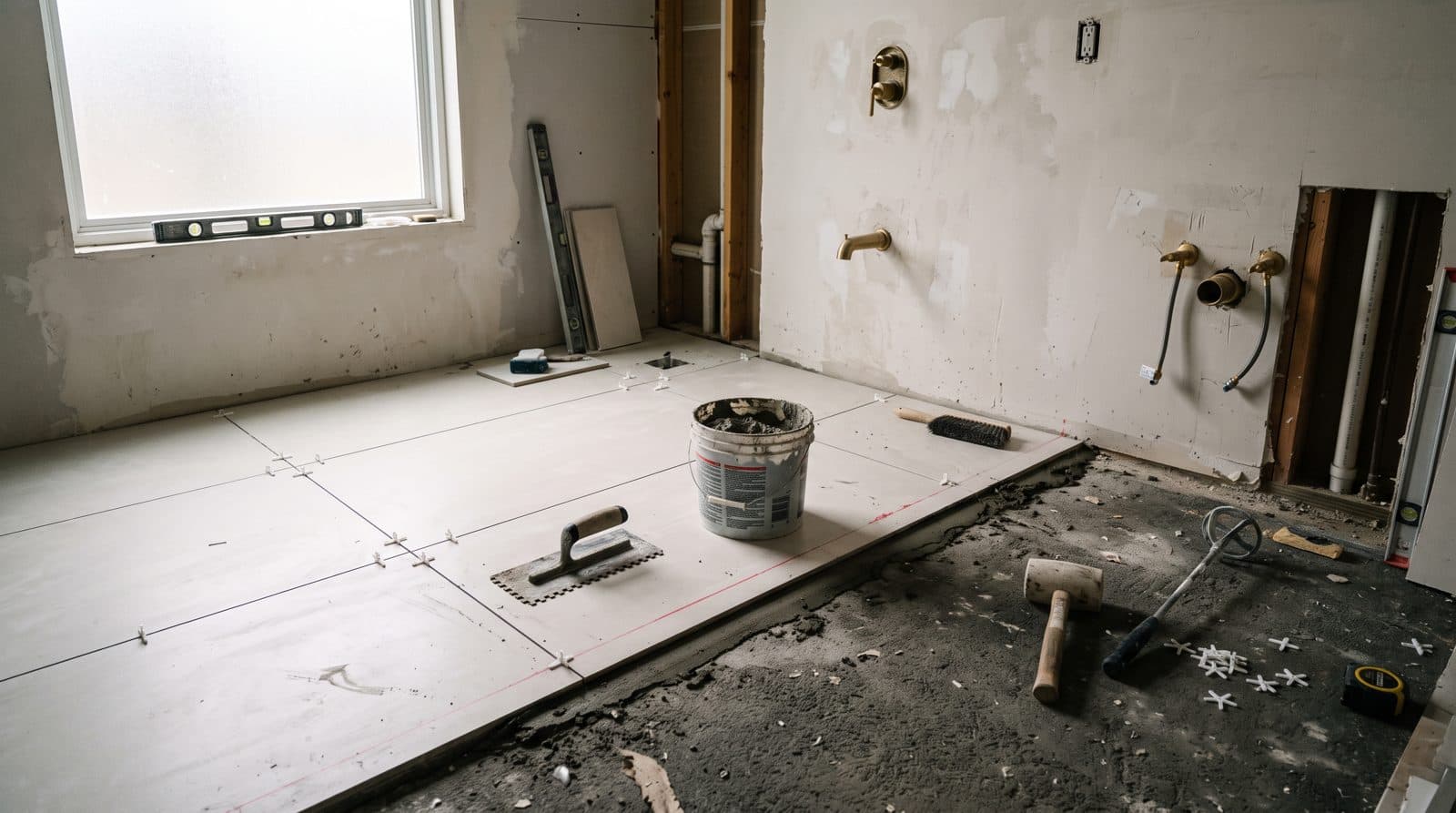
How long does tile installation take? For a standard Monmouth or Ocean County bathroom, plan on four to seven working days from the day we start to the day you can use it normally, and understand that only about half of those days have anyone in the room. The rest is mortar and grout curing, and that part cannot be bought, rushed or negotiated.
Updated October 2026.
We get asked for a number before we get asked for a price, which tells us people are mostly trying to work out where they are going to shower. Fair enough. The 2 to 5 days quoted on our tile installation page is a room without a shower pan in it, measured from prep to sealed grout. A wet area adds the waterproofing and the test that goes with it, and that is where the extra days come from. Here is the honest calendar either way, built from the wait times we already publish rather than from a national average.
What actually happens on each day
On a tub surround or a shower with the substrate already right, the shape is usually this. Day one is layout and setting the floor or the first walls. Day two finishes setting. Then the tile sits. Thinset and grout each want 24 to 48 hours minimum before the next thing happens to them, so we grout on day three or four, and if you are sealing cement grout that waits another 48 to 72 hours after the grout goes in.
Add a shower pan and waterproofing and the front of the job grows. The pan gets plugged and filled, and that water sits there somewhere between a day and three days while we watch the level, which cannot begin until the membrane under it has cured. That is a full day or two that produces nothing you can photograph, and it is the cheapest insurance on the entire project. We would rather hand back two days than find out about a leak through somebody's kitchen ceiling.
A floor on its own is faster. A powder room floor is often a one day set, grout the next morning, done. The small jobs are quick and the small wet jobs are not, and that catches people out.
Why the small bathroom takes longer than the big floor
Square footage is close to irrelevant. What drives the clock is the number of changes of direction, the number of cuts around something, and whether water is involved.
A 1,200 square foot open floor is a straight production day. A 40 square foot shower has inside corners, a curb, a niche, a bench, a drain, a mixing valve and a door to work around, and every one of those is a measured cut with no second chance. Mosaic on a shower floor is slow by nature because you are setting dozens of pieces per square foot and flattening them as you go. Large format is a different kind of slow: the tile is unforgiving, the substrate has to be flatter, and a panel that fights you costs twenty minutes you will never get back.
Demolition on a redo is its own category. Taking out an old shower is dirtier and less predictable than any part of the install, and what is behind the tile decides the week.
What stretches a schedule, and nobody warns you
Three things account for most of the delays we see on the shore.
The first is the room not being ready. If the plumber has not set the valve, if the drywall is not finished, if the floor is out of flat beyond what the tile can absorb, we are not starting, and a day lost at the front is a day lost at the back. The second is material. A tile that has to come from a regional warehouse, a special order trim, a second box because the cut count was underestimated: any of those stops a job mid-wall, and a job stopped mid-wall waits for a truck. The third is the weather, which sounds absurd for an indoor job until you try to flood test a cold bathroom in February. Membranes cure slower when the room is in the fifties, and everything downstream moves with them.
We build the buffer into what we tell you up front rather than quoting the best possible week and then explaining ourselves. If somebody has quoted you three days on a full shower, ask them where the cure time went.
Can you use the bathroom in between?
Usually not the shower, and usually yes for everything else, depending on which day it is. Once the floor is set but not grouted, foot traffic is off the table entirely. Once it is grouted, light use is normally fine within a day, though the shower itself stays out of service until the grout has cured and, if it is cement grout, until it has been sealed.
If this is your only bathroom, say so at the walkthrough. It changes the sequence we choose and sometimes it changes which grout we recommend, because the options are not all the same on the calendar. We can often work the floor and the wet area in an order that gets a toilet and a sink back sooner.
Most of the schedule is waiting, and the waiting is what makes the job last. If you want to see where those windows come from, we wrote the sealing one up in when new grout can actually be sealed, the readiness checks are in is my shower ready to tile, and if yours is a redo rather than new construction, our bathroom remodel work covers the demolition half of the week.
Send us photos and the rough dimensions and we will give you a date range with the cure days shown separately, so you can see what you are waiting on.