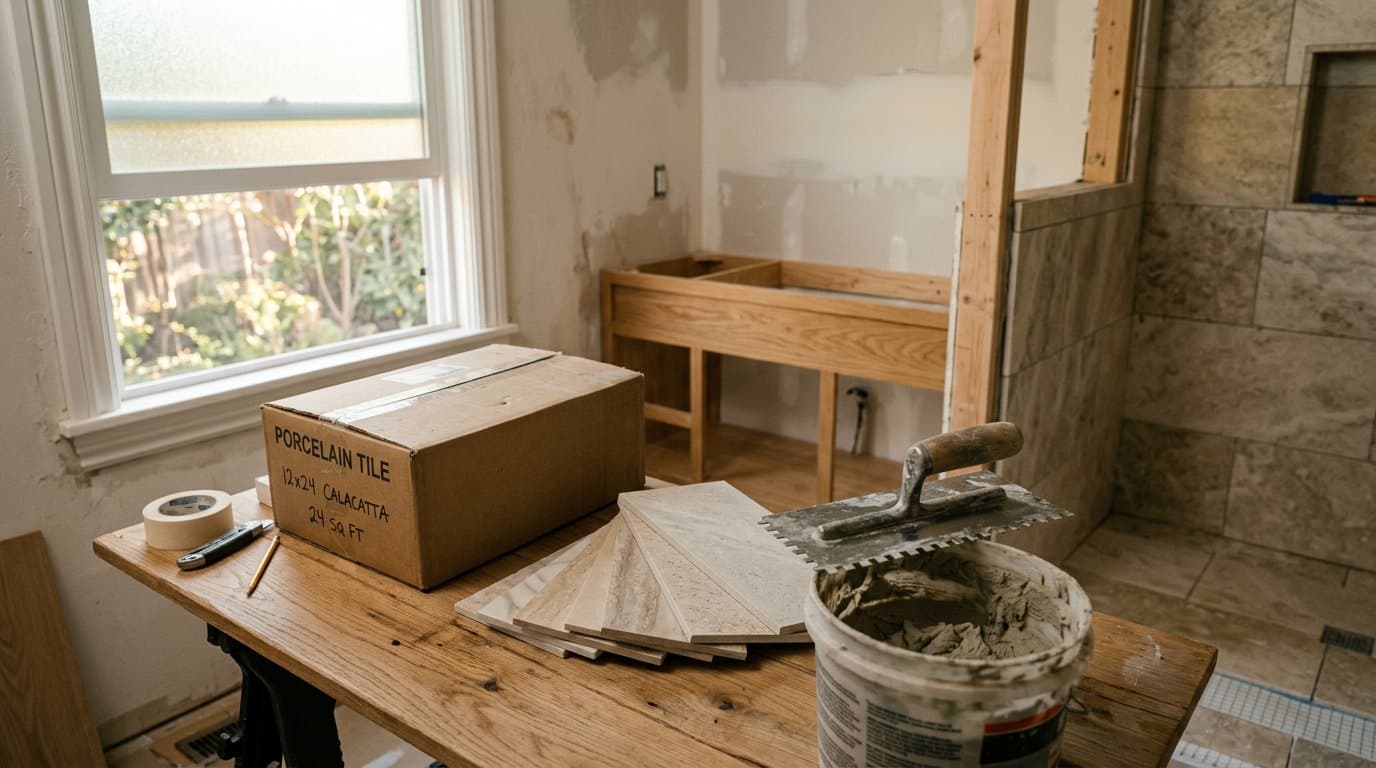
Short answer: you can supply your own tile, but order at least 10 to 15 percent overage for cuts, waste, and lot matching, buy every box from the same dye lot, and let the installer supply the mortar, membrane, and trim. Save on markup; risk a mismatched reorder if you skip the extra boxes. Updated August 2026.
This comes up on almost every estimate we write in Monmouth and Ocean County. A homeowner finds a tile they love at an outlet or online and wants to know if bringing it themselves actually saves money. It can. It can also turn a straightforward install into a delayed one, or leave you holding a mismatched reorder with no one to blame but the supply chain. The answer depends on which parts of the material list you take on and which parts you leave to us.
Jesse has been setting tile across the Jersey Shore for over 30 years, and JL Tile & Stone has run every version of this: fully installer-supplied jobs, split-supply jobs where the homeowner buys the field tile and we handle the rest, and owner-supplied jobs where the client brought every box to the site. Here is what we tell people before they order anything.
What Are the Three Ways a Tile Job Gets Supplied, and Who Carries the Risk in Each?
A tile job gets supplied three ways: the installer buys everything and marks it up, the homeowner buys the tile only and the installer supplies the trade materials, or the homeowner buys everything and the installer supplies labor alone. Each shifts risk to a different party, and the risk is what decides which option is actually cheaper once something goes wrong.
- Full installer-supplied. We source everything, mark up the material, and warranty the whole assembly. You pay more per square foot, but overage, dye lot matching, storage, and any shortage are our problem, not yours.
- Split-supply. You buy the field tile, we supply the mortar, membrane, waterproofing, and trim, and we install it all. This is what we recommend most often. The decision you care about stays yours, and the materials that decide whether the tile stays on the wall stay with the people who spec them daily.
- Fully owner-supplied. You buy and deliver everything, including mortar, membrane, and trim, and we provide labor only. This is our lowest per-square-foot rate, and also the arrangement where a wrong mortar, a mismatched trim height, or a short delivery becomes a job-site delay you own, not a material cost we absorb.
None of the three is universally right. A homeowner who found a discontinued closeout tile at a steep price is a good candidate for split-supply. A homeowner who wants one phone call, one invoice, and zero exposure if a box arrives wrong is a good candidate for full installer-supplied. The mistake is picking based on the sticker price of the tile alone and never asking who eats the cost if the order is short, late, or from the wrong lot.
Why Is a 10 Percent Overage Not Just a Padding Trick?
A 10 percent overage is not padding because it covers three real costs on every job: cutting waste at edges and fixtures, breakage in transit and on site, and a reserve in case a repair is ever needed. On a straight room with a simple layout, 10 percent covers it. On a room with heavy cuts (a diagonal layout, a tub surround with a niche, a herringbone or basketweave pattern), we tell clients to order 15 percent.
The part that surprises most first-time buyers: the overage is not just insurance against running short mid-job. It is your only source of matching tile if a piece cracks two years from now. Without it, a future repair means a reorder from the manufacturer, and that reorder is where the real risk lives.
That reserve matters because of dye lots. A dye lot is the batch a tile was fired or printed in, and a reorder from a different dye lot can visibly not match even though the box carries the exact same product name and SKU. Tile is manufactured in production runs, and pigments, glazes, and firing conditions shift slightly run to run. A porcelain tile that looked identical to the showroom sample can read a full shade lighter once it is on your floor next to tile from an earlier lot.
This is why overage matters more than the tile's sticker price. If you buy exactly the square footage and no more, and a single tile cracks during install or years later, the replacement almost never comes from the same dye lot. Manufacturers do not hold a lot open indefinitely, and a "matching" reorder is a genuine gamble. We check the lot number on every box before setting the first tile, and if a single order carries two lot numbers, we sort and blend them across the room on purpose rather than let one wall read differently than another.
What Happens to Your Warranty When You Supply the Material?
When you supply the material, our workmanship warranty still covers the installation, but the tile itself falls under the manufacturer's warranty, and any defect, coverage shortfall, or lot mismatch becomes a claim you file, not one we absorb. We stand behind full mortar coverage, correct substrate prep, proper waterproofing, and a level, sound field. What we cannot warranty is a manufacturing flaw or a box count that was short before it reached the job site.
On a fully installer-supplied job, that line does not exist; we sourced it, and a defect claim runs through us. On a split-supply or owner-supplied job, we flag anything that looks wrong when material arrives (visible defects, wrong size or finish, damaged boxes) before we set a single piece, but the manufacturer warranty on the material itself is between you and whoever you bought it from.
Which Materials Should You Almost Never Buy Yourself?
You should almost never buy the mortar, the waterproofing or uncoupling membrane, or the trim profiles yourself, because all three have to be matched precisely to the tile and substrate, and getting one wrong is invisible on install day and expensive two winters later.
| Material | Why it needs a tile setter's spec |
|---|---|
| Mortar (thinset) | Large-format porcelain needs a large-and-heavy-tile mortar, not a stock wall thinset, and the trowel notch size has to match the tile size for full coverage. The wrong mortar or an under-troweled bed is the leading cause of hollow spots and cracked tile we tear out. |
| Membrane (waterproofing / uncoupling) | Sheet and liquid membrane systems are engineered and warrantied together as a pair. Mixing brands, or skipping the membrane on a shore subfloor that flexes, is where most of the shower failures we tear out started. |
| Trim (edge profiles, transitions) | Metal edge profiles come in heights measured to the millimeter to match tile-plus-mortar-bed thickness. Order the wrong profile height and it sits proud of the tile or sinks below it, with no fix short of pulling the trim and redoing the edge. |
Grout is more flexible. Sanded versus unsanded and epoxy versus cement are real decisions, covered in how to pick the right grout type, but grout does not carry the same job-stopping risk as a mismatched membrane or the wrong trim height showing up on delivery day.
Then there is getting the tile to the house. Delivery, storage, and acclimation matter because tile has to sit at the job site, at room temperature, for at least 48 to 72 hours before it is set, and a homeowner-managed delivery that misses that window can delay the whole schedule. Porcelain and ceramic move slightly with temperature and humidity, and a pallet pulled off a truck in August or a January cold snap and set the same day is more likely to show grout-line stress later. When we supply the tile, acclimation is built into our schedule automatically. When you supply it, the delivery date has to land before our crew does, with enough runway to sit, or a delayed truck becomes a delayed start.
Storage is the other piece people underestimate. A full bathroom re-tile can mean 15 to 25 boxes sitting dry and flat for several days, not stacked in a garage where a car door dings the top box, and not left outside where a storm gets into the cardboard.
How Do You Have This Conversation Before the Quote, Not During the Install?
You have this conversation before the quote by telling us up front which materials you plan to supply, so the estimate reflects real labor-only or split pricing instead of a number built assuming we source everything. Here is the order we walk through it on a walkthrough:
- Tell us what you are supplying. Tile only, tile plus trim, or everything. Say it before we price the job, not after.
- We calculate your overage together. We measure the room and the layout and give you the exact box count to order, including the 10 to 15 percent buffer.
- We confirm dye lot on the order. We tell you to request that every box ship from the same production run, and to keep the packing slip with the lot number for any future reorder.
- We spec the trade materials. Even if you are not buying them, we tell you what mortar, membrane, and trim the job needs so there is no confusion about who is sourcing what.
- We set a delivery window against our schedule. Tile needs to be on site and acclimating before our crew arrives, not arriving the same morning.
- We put the warranty split in writing. Workmanship is covered by us regardless of who supplied the material; the material itself is covered by whoever manufactured or sold it.
Skip this conversation and the risk does not go away, it just surfaces mid-job: a delivery that has not arrived when the crew shows up, or a mortar bag that is the wrong type for a large-format tile. Every one of those is a two-minute question on the walkthrough and a scheduling headache once the crew is on site with nothing to set.
Where the Installer Actually Makes Money on Material, and Why It Can Still Be the Cheaper Path
We will say this plainly because most contractors will not: when we supply the tile, we mark it up, to cover the sourcing time, the distributor relationship, the overage math, storage until install day, and the material warranty backing we stand behind. That markup is real, and a homeowner who does the legwork to buy tile at a real discount and manage overage, dye lot, and delivery themselves can genuinely come out ahead on the material line.
Where it can still be cheaper to let us supply it is when the time and risk of managing delivery windows, dye lots, and a possible reorder is worth more to you than the markup, or when the tile you want is only available at a price close to what we would pay through trade accounts anyway. We would rather tell you that honestly on the walkthrough than let you find out after a delivery goes sideways.
Frequently Asked Questions
- Can you bring your own tile and have JL Tile & Stone just install it?
Yes. Split-supply and fully owner-supplied jobs are both work we do regularly in Monmouth and Ocean County. Tell us on the walkthrough what you plan to supply and we will price the job as labor-only or split accordingly, and spec exactly what overage and trade materials it needs.
- How much extra tile should you order if you are buying it yourself?
Order at least 10 percent over your measured square footage for a simple layout, and 15 percent or more for a room with heavy cuts, like a diagonal layout, multiple fixtures, or a pattern like herringbone. That overage covers waste during install and gives you matching stock for a future repair without a reorder.
- Is the warranty still valid if you supply your own tile?
Our workmanship warranty on the installation stands regardless of who bought the tile. The material itself is covered by the manufacturer's warranty, so a defect, shortage, or lot issue is a claim you file with the manufacturer or seller, not with us.
- Why not buy the mortar and membrane yourself too?
You can, but we discourage it. Mortar has to match the tile size and substrate, and membrane systems are engineered and warrantied as matched pairs. Getting either one wrong does not show up on install day; it shows up as a hollow tile or a failed shower wall a year or two later.
- What happens if your tile arrives in two different dye lots?
We check the lot number on every box before setting anything. If an order arrives split across two lots, we sort the boxes and blend them deliberately across the room, mixing both lots in every area rather than setting one lot on one wall and the other on another, which is the arrangement most likely to show a visible line.
- Do you serve my area if the tile is owner-supplied?
Yes. JL Tile & Stone serves Monmouth and Ocean County, NJ only, including Toms River, Brick, Freehold, Manalapan, Morganville, and Howell. We handle installer-supplied, split-supply, and fully owner-supplied jobs the same way across our whole service area, with the same overage and dye lot check regardless of who bought the material.
What to Buy Yourself and What to Leave to Us
Supplying your own tile can genuinely save money, but the savings live in the details most homeowners never ask about: order 10 to 15 percent overage, confirm every box ships from the same dye lot, and let the installer spec or supply the mortar, membrane, and trim, because those three materials fail silently and expensively when they do not match the tile and substrate. The tile itself is the one material where doing the legwork yourself is low-risk and can pay off. The materials underneath it are where we earn the labor rate, and where a shortcut is the most expensive thing on the job. If you are planning a tile project in Monmouth or Ocean County and want an honest read on what to supply yourself and what to leave to us, call or text JL Tile & Stone at (848) 210-1946, or request a free quote. For the full scope of a floor or shower install, see our tile installation service. For what goes underneath the tile no matter who supplies it, read our guide to tile underlayment at the Jersey Shore. Serving Monmouth and Ocean County only, from Toms River and Brick up through Freehold.