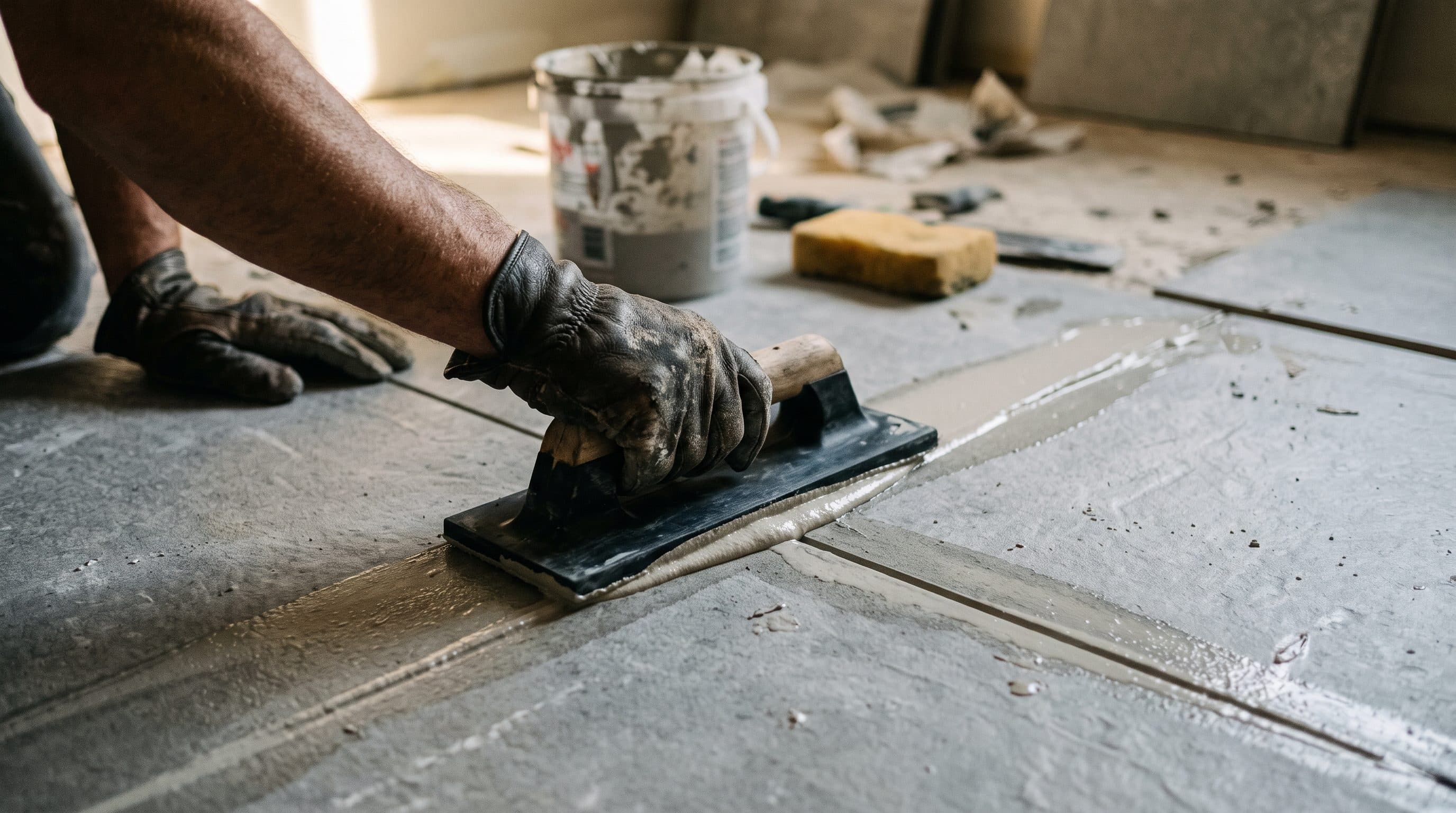
Short answer: pick grout by joint width first, not by the tile. Use unsanded grout for joints under 1/8 inch and sanded grout at 1/8 inch or wider. Then choose the material: epoxy for wet zones, cement for dry areas, urethane where you want stain resistance without an epoxy install. Updated August 2026.
Every tile job we quote in Monmouth and Ocean County reaches the same moment: the tile is picked, and now someone has to pick the grout. Homeowners walk in worried about color, and the showroom hands them a color chart. Color matters, and we covered it in how to choose a grout color, but color is the last decision, not the first. The first decision is joint width, because joint width decides the grout type, and the grout type decides how long the joint lasts before it fails.
Here is the order a tile setter actually works in. Jesse has been setting tile across the Jersey Shore for over 30 years, and this is exactly how we spec grout on a shower, a mudroom, and a patio, three rooms that want three different answers.
Sanded or Unsanded Grout? The Joint Width Decides, Not the Tile
The joint width decides between sanded and unsanded grout, not the type of tile you bought. Unsanded grout is a fine cement mix with no sand, and it belongs in tight joints under 1/8 inch. Sanded grout has graded sand added for body, and it belongs in joints 1/8 inch and wider. The reason is mechanical, not a preference. Unsanded grout shrinks and slumps in a wide joint, so a 1/4-inch floor joint packed with it cracks and pulls back from the tile edges as it cures. Sanded grout holds its shape because the sand gives it structure. Run it the other way, sanded grout into a 1/16-inch glass mosaic joint, and the grains are too big to pack the joint and they scratch the polished face while you tool it.
So the width sets the type before anything else. A quick read on where the common joints land:
- Under 1/8 inch (1/16 inch is typical): unsanded grout. Polished stone, glass mosaic, tight-set wall tile, rectified porcelain run to a minimal joint.
- 1/8 inch and wider: sanded grout. Most floor tile, large-format installs, natural stone with a 3/16-inch joint, anything that needs the joint to carry weight and movement.
- The gray zone at exactly 1/8 inch: either works, and the material you choose (below) often makes the call. Some epoxy and urethane grouts are rated across the whole range and take the width question off the table.
One caution that catches people: rectified large-format tile does not mean a hairline joint. The Tile Council of North America calls for a grout joint of at least 1/8 inch on rectified tile, which pushes almost every large-format floor into sanded grout. We get into why the joint matters on big tile in large format tile installation in NJ.
Cement, Epoxy, or Urethane: What Is Each One Actually Good At?
Each grout family is genuinely good at one thing, and picking wrong means paying for a strength you did not need or missing the one you did. Cement is cheap, forgiving to install, easy to patch and color-match, and porous forever. Epoxy is waterproof, non-porous, stainproof, and never needs sealing, and it punishes a slow installer because it sets hard and fast. Urethane is the middle path: pre-mixed and pre-sealed, far more stain-resistant than cement, and it installs more like cement than epoxy, but it is not rated for constant submersion. Here is the same information as a spec sheet, which is how we read it on a job.
| Grout type | What it is genuinely good at | Needs sealing? | Typical joint width |
|---|---|---|---|
| Unsanded cement | Tight joints on walls, glass, and polished stone; cheap and easy to color-match | Yes, every 1 to 2 years | 1/16 inch to under 1/8 inch |
| Sanded cement | Floors and wide joints; holds shape and carries traffic; cheapest option | Yes, every 1 to 2 years | 1/8 inch to 1/2 inch |
| Epoxy | Showers, wet zones, and stainproof surfaces; waterproof and maintenance-free | Never | 1/16 inch to 1/2 inch (formula-dependent) |
| Single-component urethane | Dry to lightly damp areas; stain resistance without an epoxy install | No, it comes pre-sealed | 1/16 inch to 1/2 inch |
Epoxy grout when to use is the question we get most, so the short version: use epoxy anywhere water sits or stains threaten, meaning shower floors and walls, tub surrounds, and the backsplash behind a range. The full cost and install tradeoff, including the 45-to-75-minute working window that ruins a slow crew's tile face, is in epoxy vs cement grout for a shower. Urethane grout is the answer for a homeowner who wants better-than-cement stain resistance on a mudroom or laundry floor without paying for an epoxy crew, as long as the floor is not a wet zone.
How Does Where the Tile Lives Change the Grout Answer?
Where the tile lives changes the answer because the room decides how much water, traffic, and staining the joint has to survive. The joint width tells you sanded or unsanded, but the room tells you cement, epoxy, or urethane, and the two have to agree before you buy. A shower floor and a dry powder-room backsplash can use the same tile at the same joint width and still need completely different grout. The tests we run on every room:
- Does standing water sit on it? Shower floors, curbless entries, and pool coping say epoxy. Cement in constant water is a resealing chore that eventually loses.
- Does it get soaked but not submerged? Shower walls and tub surrounds want epoxy for the color hold and the zero maintenance, even though cement can survive there if it is sealed on schedule.
- Does it stain but stay dry? Kitchen floors, mudrooms, and entryways are where urethane earns its price, or sanded cement in a mid-tone that hides wear.
- Does it freeze? Patios, pool decks, and outdoor kitchens need a grout rated for exterior freeze-thaw, a high-performance cement or a purpose-made exterior epoxy, never a standard interior bag.
That last one matters more on the coast than most installers treat it. A patio joint in Point Pleasant or Long Beach Island takes water in, freezes it in January, and the expansion pops standard grout loose. The same freeze-thaw logic that governs the layers under the floor, covered in tile underlayment at the Jersey Shore, governs the grout on top of it.
What Actually Needs Sealing, and What Never Did?
Cement grout needs sealing and always has, epoxy and urethane never need it, and the sealer marketing sold on top of that is mostly noise. A penetrating sealer on cement soaks into the pores and slows water and stains from wicking in, and it wears off in 1 to 2 years, sooner on a scrubbed floor. That is the maintenance task homeowners skip most, which is why so much cement grout darkens and crumbles before its time. Epoxy and urethane are non-porous or pre-sealed, so there is nothing for a sealer to penetrate and no reseal cycle to miss. Where the marketing goes sideways:
- "Sealed" cement grout out of the bag. Some cement grouts include a water-repellent additive. It helps, but it is not permanent, and it does not turn cement grout into epoxy. Treat it as cement that still needs sealing on schedule.
- Sealing epoxy or urethane. A crew that offers to seal your new epoxy grout is selling you a step that does nothing. There is no pore to fill.
- One coat forever. No penetrating sealer on cement is a one-and-done. If nobody is going to reseal a cement-grouted shower every couple of years, the honest move is to spec epoxy up front and delete the chore.
Finish rides along with sealing. Cement cures to a matte, slightly textured finish that reads soft and traditional. Epoxy cures denser, with a faintly satin finish that holds its color hard. Neither is glossy, and any grout that looks shiny is either still curing or has haze locked on the tile face, which is an install problem, not a finish choice.
Why Does a Grout Choice Show Up as a Callback Two Years Later?
A grout choice shows up as a callback two years later because grout failures are slow, and the wrong grout looks perfect on handoff day. The tile passes the walkthrough, the color is right, and then the joint quietly does what the wrong grout was always going to do. The failures we get called back for, and the choice behind each one:
- Cracked, pulled-back floor joints. Unsanded grout run into a wide floor joint. It shrank as it cured and let go of the tile edges.
- Dark, crumbling shower-floor grout. Cement grout in a daily-wet zone that never got resealed. The pores drank water, fed mildew, and broke down.
- A hazed, sticky tile face. Epoxy grouted by a crew that works at cement speed and missed the working window. This is an install failure, not a material failure.
- Cracked corners. Rigid grout packed into a change-of-plane joint that should have been flexible sealant. Grout has no give, so the moving joint splits it.
Notice that two of these are not grout-material problems at all, they are joint problems. Every change-of-plane joint, where a wall meets the floor or another wall, moves with the house and gets a color-matched silicone sealant, not grout, no matter which grout is in the field. Skipping that is the most common reason a good grout choice still cracks in the corner.
What Do We Spec on a Shower vs. a Mudroom vs. a Patio?
We spec three different grouts for those three rooms because each has a different worst enemy: water in the shower, staining in the mudroom, and freeze-thaw on the patio. This is the practical payoff of everything above, and it is what goes on the job sheet for a Monmouth or Ocean County home.
- Shower: epoxy grout in the field, wall and floor, over a full bonded waterproof membrane, with every corner and floor-to-wall joint in color-matched silicone. Joint width follows the tile, usually 1/16 inch on walls and 1/8 to 3/16 inch on a mosaic floor for traction. The waterproofing does the sealing; the epoxy holds its color and never asks for maintenance.
- Mudroom or entry floor: single-component urethane or a mid-tone sanded cement, joint at 1/8 to 3/16 inch. The enemy is salt, sand, and grit tracked in off the shore, not standing water, so stain resistance and a wear-hiding color beat waterproofing. Urethane skips the reseal cycle; if the budget says cement, a mid-gray hides the grit.
- Patio or pool deck: a high-performance cement or exterior-rated epoxy graded for freeze-thaw, joint at 3/16 to 1/2 inch to move with the slab, with real expansion joints planned into the field. A standard interior bag on a shore patio is a spring tear-out waiting to happen.
Same installer, same standards, three different grouts, because each room asked a different question. That is the whole method: joint width first, then material by room, then color last.
Frequently Asked Questions
- How do I pick the right grout type in one sentence?
Measure the joint first: unsanded grout under 1/8 inch and sanded grout at 1/8 inch or wider, then choose the material by room, epoxy for wet zones, urethane for dry areas that stain, and cement for dry areas on a budget. Color is the last step, because a joint set at the wrong width or in the wrong room fails no matter what color it is.
- What is the difference between sanded vs unsanded grout?
Sanded grout has graded sand for body so it holds its shape in joints 1/8 inch and wider, which is why it goes on most floors and large-format work. Unsanded grout is a finer cement mix for tight joints under 1/8 inch, like glass mosaic and polished stone, where sand grains are too coarse to pack the joint and scratch the tile face. Use the width to choose, not the tile.
- When is epoxy grout the better choice over cement?
Use epoxy grout anywhere water sits or stains threaten: shower floors and walls, tub surrounds, and the backsplash behind a range. Epoxy is non-porous and waterproof, so it never needs sealing and does not grow mildew the way cement does in a wet room. It costs a few dollars more per square foot and demands a skilled installer, but in a wet zone it eliminates the resealing cement needs every 1 to 2 years.
- What is urethane grout and when does it make sense?
Urethane grout is a single-component, pre-mixed and pre-sealed grout that resists stains far better than cement and installs more like cement than epoxy. It makes sense on dry to lightly damp areas, a mudroom, laundry, or kitchen floor, where you want better-than-cement performance without an epoxy crew. It is not rated for constant submersion, so it does not belong on a shower floor or in a pool.
- What grout should I use for large format tile?
Large format tile almost always takes sanded grout, because rectified large-format tile still calls for a joint of at least 1/8 inch under the Tile Council of North America standard, and that width needs sand to hold its shape. In a wet large-format install like a shower wall, use an epoxy grout rated across that joint range so you get the waterproofing and the color hold at once. A hairline joint on big tile is a myth that leads to lippage and cracked grout.
- Does the grout joint width really change which grout you can use?
Yes, joint width is the first filter. Unsanded grout slumps and cracks in a joint 1/8 inch or wider, and sanded grout is too coarse to pack a joint under 1/8 inch and can scratch glass or polished stone. Some epoxy and urethane grouts are rated across the full range, which simplifies the decision, but with cement you match the sanded-versus-unsanded choice to the width before anything else.
Width First, Then the Room, Then the Color
How to pick grout type comes down to three decisions in order: joint width picks sanded or unsanded, the room picks cement, epoxy, or urethane, and color comes last. Get the order right and the joint outlasts the tile. Start with color and ignore the width and the room, and you get a callback two years later for a cracked floor joint or a crumbling shower. If you are planning tile work in Monmouth or Ocean County and want the grout speced right the first time, call or text JL Tile & Stone at (848) 210-1946, or request a free tile and grout quote. For the full scope of a floor or a shower build, see our tile installation service and our bathroom remodel and shower build service. Serving Monmouth and Ocean County only, from Toms River and Brick up through Red Bank and Rumson.