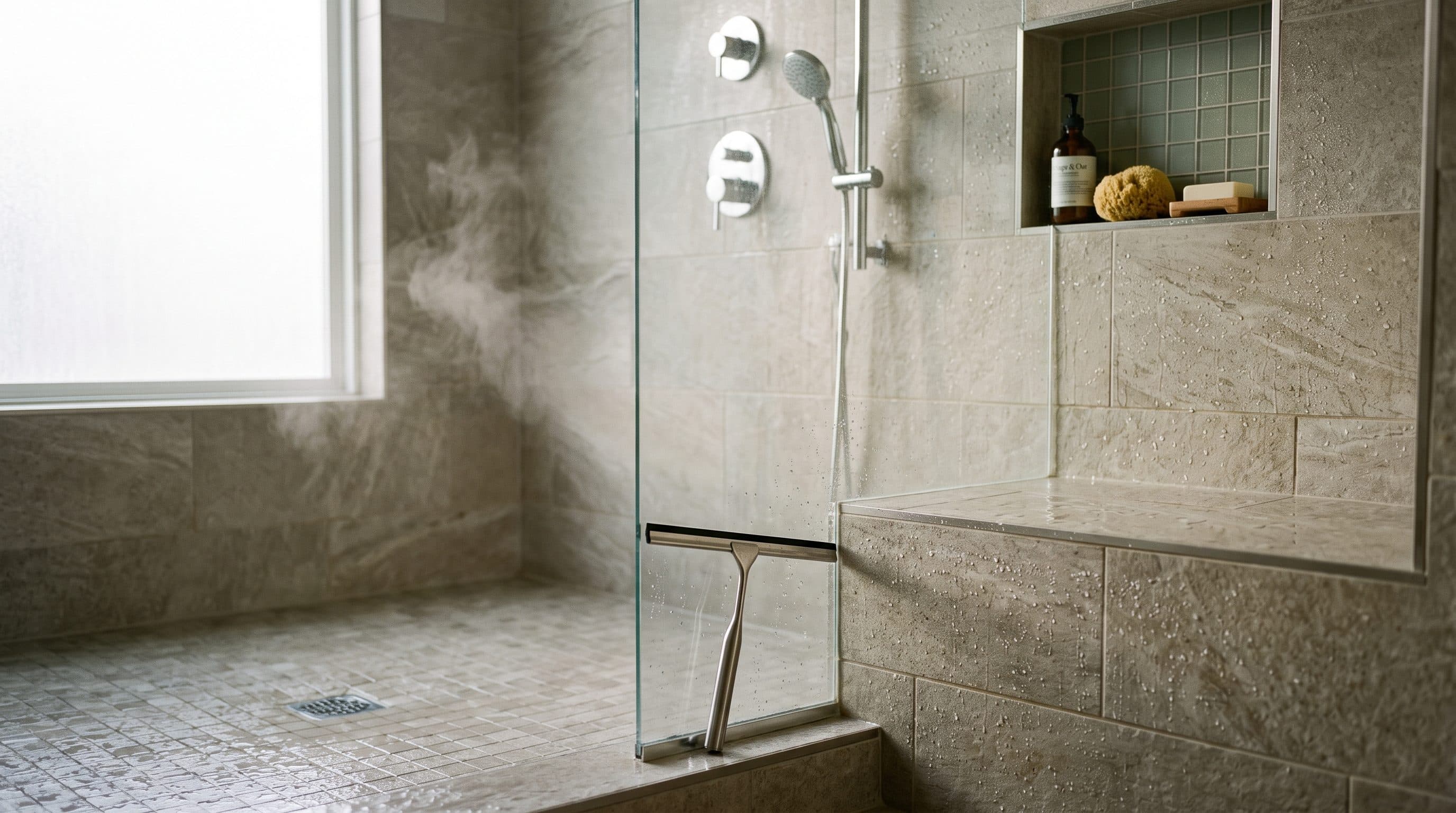
Short answer: to maintain a tile shower so it lasts its full 20 to 30 years, squeegee the walls after every use, reseal cement grout about once a year at the Jersey Shore, replace the caulk at every change of plane the moment it pulls away, and keep every acidic cleaner off the grout. Most tile does not fail from how it was installed. It fails from how it was maintained. Updated September 2026.
We get called to tear out showers that are eight or nine years old, and the tile itself is usually fine. What failed is the grout, the caulk, and the waterproofing behind them, and almost always it traces back to a maintenance habit, not an install mistake. Jesse has been setting and repairing tile across Monmouth and Ocean County for over 30 years, and JL Tile & Stone has learned that the difference between a shower that lasts three decades and one that fails in five is a few minutes a week and one honest decision about what you spray on it. Here is the routine we give every client, and the reasoning behind each part of it.
How Do You Maintain a Tile Shower Week to Week?
You maintain a tile shower by getting the water off the walls before it evaporates, because every drop that dries on the tile leaves behind the minerals and soap that become scum, and scum is what holds moisture against the grout. The single highest-value habit is a squeegee, and it takes about fifteen seconds. Here is the routine we tell homeowners to actually keep:
- Squeegee every wall after every shower. Top to bottom, including the glass and the pan. This one habit removes more mineral buildup than any product you can buy.
- Run the exhaust fan during the shower and for 20 minutes after. Humidity is the slow killer, and at the Shore the air is already carrying moisture before you turn the water on.
- Wipe the pan and the bottom corners with a dry towel once a day. The lowest few inches of the shower stay wet the longest and fail first.
- Do one weekly clean with a pH-neutral cleaner. Not a daily acid spray. A neutral cleaner and a soft brush on the grout lines, then rinse.
- Leave the door or curtain open between uses. A closed shower stays a wet cave. An open one dries.
That is the whole weekly program. No specialty products, no scrubbing marathons. The showers that reach 25 years are the ones where the water never got to sit.
What Cleaner Is Quietly Eating Your Grout?
The cleaner eating your grout is almost certainly an acidic one, and most of the popular daily shower sprays and soap-scum removers are acidic by design. Here is the chemistry that matters: standard cement grout is portland-based, which means it is held together by calcium compounds, and acids dissolve calcium. Many bathroom cleaners sit at a pH of 2 to 3 because that low pH is exactly what cuts soap scum fast, and that same low pH slowly eats the surface of your grout every time you use it. Cement grout is stable in a roughly neutral range and starts breaking down below about pH 6. Bleach sits at the other extreme, high pH, and while it will not dissolve grout the way acid does, it degrades the sealer and can wick down to attack the waterproofing over time.
What to keep off the grout entirely:
- Anything acidic: vinegar, lemon, and any soap-scum or lime-and-rust remover. These read pH 2 to 3 and etch cement grout and natural stone on contact.
- Straight bleach as a routine cleaner. Fine for an occasional spot on mold, never as your everyday spray. It breaks down sealer and can reach the membrane.
- Abrasive powders and stiff wire brushes. They scratch the grout open and give water more surface to sit in.
- Any "fast" scum remover that does not say pH-neutral. Fast almost always means acidic.
Use a pH-neutral cleaner made for tile and stone, a soft brush, and a rinse. It is slower on scum than an acid spray, which is the point. The scum comes off, and the grout stays intact.
What Actually Accumulates in a Shower Pan, and How Do You Get It Out?
What accumulates in a shower pan is a mix of body oils, soap curd, and hard-water minerals, and it builds fastest in the low corners and along the drain where water pools last. Cleaning a shower pan is not about a stronger chemical, it is about breaking the film without acid. Much of Monmouth and Ocean County runs on moderately hard water, roughly 7 to 10 grains per gallon, so the white haze you see on a dark pan is calcium and magnesium left behind as the water dries. That mineral film is what makes a pan look permanently dirty even right after you clean it.
To get a pan actually clean without damaging the grout or the pan surface: wet it, spread a paste of baking soda and water over the film, let it sit for ten minutes, then work it with a soft nylon brush and rinse. Baking soda is mildly alkaline and abrasive enough to lift the film without the low pH that eats grout. For a stubborn mineral haze, a cleaner labeled for tile and stone at neutral pH, left to dwell, does the same job safely. The mistake we see constantly is someone reaching for a lime-and-scale acid product on the pan, which clears the haze once and quietly opens every grout joint in the floor, right where water most wants to get in.
Sealing a Tile Shower: What Does It Do, What Does It Not, and How Often?
Sealing a tile shower means applying a penetrating sealer to the cement grout so it repels water instead of drinking it, and it does exactly one thing: it buys you time by slowing how fast water soaks into a porous joint. What it does not do is waterproof the shower. The waterproofing is the membrane behind the tile, and no surface sealer replaces it, which is worth understanding before you trust a sealed grout line to protect anything. Sealer keeps the grout from absorbing water and staining between cleanings. That is its whole job, and it is a real one.
How often depends on where you are and what grout you have. Cement grout at the Shore, with coastal humidity and hard water, wants resealing about every 12 months. The test is simple: drip a few drops of water onto a grout line and watch. If it beads, the seal is holding. If it darkens and soaks in within about a minute, it is time to reseal. Epoxy grout is a different story, because it is non-porous and does not need sealing at all, which is one of the reasons we recommend it for wet areas in our breakdown of epoxy vs cement grout for a shower.
| Surface | Reseal interval at the Shore | How to check |
|---|---|---|
| Cement grout, shower walls | About every 12 months | Water drop soaks in under a minute means reseal |
| Cement grout, shower floor | Every 9 to 12 months | Floor grout wears faster underfoot |
| Epoxy grout | Never | Non-porous, nothing to seal |
| Natural stone tile | Every 12 to 18 months | Water darkens the stone means reseal |
Caulk is the other seal in a shower, and it is a maintenance item because it sits at every place two surfaces move independently, and a joint that flexes cannot be filled with something rigid and left forever. Every change of plane in a shower, the inside corners, the wall-to-pan joint, and the line where tile meets the tub or the curb, gets caulk rather than grout precisely because it moves. Caulk is a sacrificial seal, designed to be replaced. When it shrinks, cracks, or pulls away from one side, that gap is a direct path for water to reach the substrate, and it needs to be cut out and redone, not painted over.
Plan on redoing the caulk in a shower every one to two years, sooner if you see it lifting or darkening with mold underneath. The job is cutting the old bead out cleanly, drying the joint fully, and running a new bead of a mildew-resistant sealant made for wet areas. If your caulk keeps failing in the same corner within months, that is not a caulk problem, it is movement behind the tile, and it is the same signal we describe in why shower tile cracks.
What Early Signs Separate a Repair From a Rebuild?
The early signs that separate a cheap repair from a full rebuild all come down to whether water has reached the substrate yet, and catching them early is the entire difference in cost. A cracked grout line caught this month is a repair. The same crack ignored for a year is a rebuild, because water spent that year behind the tile. Here is what to watch for and what each sign usually means:
- Grout cracking in a flat run that you refill and it cracks again. Something is moving behind the tile.
- Caulk pulling away at a corner or the pan. Repairable now, a water path if left.
- A tile that sounds hollow when tapped. It has lost its bond, and water may already be in the joint.
- A soft or spongy spot underfoot or in a wall. The substrate is wet. This one is urgent, and usually past the repair line.
- A musty smell that does not clear. Mold behind the wall, which means moisture has been there a while.
The first two are maintenance. The last two usually mean the waterproofing or the substrate under the tile has failed, which is exactly what we cover in the underlayment under a Jersey Shore bathroom and in how long a tile shower actually lasts. If you are not sure which side of the line your shower is on, that is worth a look before you spend money on either.
Why Is Natural Stone a Different Routine Entirely?
Natural stone is a different routine because it is porous and also chemically reactive, and the acidic cleaners that merely wear on cement grout will permanently etch marble, travertine, and limestone on contact. An acid spray on a Calacatta marble shower dissolves a dull spot into the polish that no amount of wiping brings back. Stone showers get pH-neutral cleaners only, no exceptions, and they get sealed more attentively than a porcelain-and-grout shower, usually every 12 to 18 months, because the stone body itself absorbs water, not only the joints.
The squeegee habit matters even more on stone, since hard-water minerals dry into a haze that is harder to remove from a honed or polished surface without reaching for something acidic, which is the one thing you cannot use. If you have a stone shower and you have been cleaning it with a supermarket bathroom spray, stop today and check the label for pH-neutral. That single change protects a surface that is genuinely expensive to restore.
Frequently Asked Questions
- How often does the grout in a tile shower need resealing?
At the Jersey Shore, reseal cement grout about once a year, and the shower floor every 9 to 12 months since floor grout wears faster underfoot. The reliable test is to drip a few drops of water on a grout line: if it beads, the seal is fine, and if it soaks in and darkens within about a minute, it is time to reseal. Epoxy grout is non-porous and never needs sealing.
- What should you never use to clean shower grout?
Never use anything acidic, which includes vinegar, lemon, and most soap-scum and lime removers, because standard cement grout is calcium-based and acids at pH 2 to 3 dissolve it. Also skip straight bleach as a routine cleaner, since it breaks down the sealer and can reach the waterproofing over time, and avoid abrasive powders and wire brushes that scratch the grout open. Use a pH-neutral tile and stone cleaner with a soft brush.
- Do you really need to squeegee the shower every time?
Yes, and it is the single most valuable thing you can do for a tile shower. A fifteen-second squeegee after every use removes the water before it evaporates and leaves behind the minerals and soap that become scum, which is what traps moisture against the grout and caulk. Homeowners who squeegee consistently reseal less often and rebuild years later than those who do not.
- How do I clean a cloudy or scummy shower pan?
Spread a paste of baking soda and water over the pan, let it dwell for about ten minutes, then work it with a soft nylon brush and rinse. The cloudiness is usually hard-water minerals plus soap film, and baking soda lifts it without the acid that eats grout. Do not reach for a lime-and-scale acid product, which clears the haze once but opens every grout joint in the floor where water most wants to get in.
- Does epoxy grout need to be sealed?
No. Epoxy grout is non-porous, so it does not absorb water and there is nothing for a sealer to soak into. That is one of the main reasons we recommend it for showers at the Shore, where humidity and hard water are hard on cement grout. If you have epoxy grout, your maintenance is just squeegeeing, neutral cleaning, and keeping the caulk lines fresh.
- Do you service tile showers in my area?
Yes. JL Tile & Stone maintains, repairs, and rebuilds tile showers across Monmouth and Ocean County, and we will tell you honestly whether yours needs a simple regrout and reseal or something more before we quote it. Send a few photos or book a look through our contact page, and see the full range of what we do on our services page.
Get an Honest Look Before It Becomes a Rebuild
If your grout is soaking up water, your caulk is pulling away, or a tile sounds hollow, the cheapest day to deal with it is today. Water damage behind tile only accelerates, and the gap between a repair and a rebuild is measured in months. JL Tile & Stone gives free, honest assessments across Monmouth and Ocean County. Call Jesse directly at (848) 210-1946 or book an estimate through our contact page.