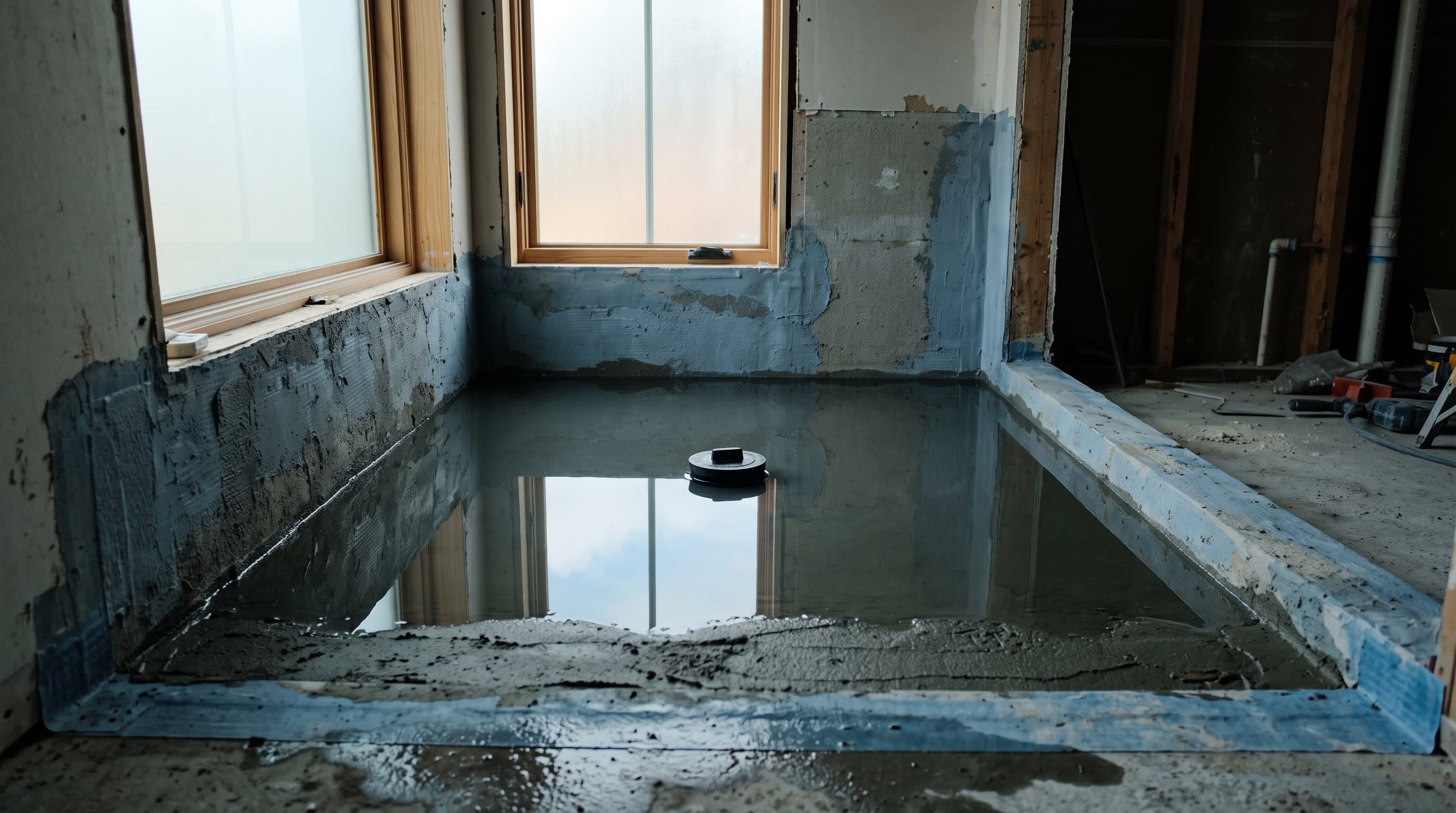
Before a single tile goes on your shower floor, the waterproofing should be plugged, filled with water and left to sit. The industry procedure most of us work from is a 24 to 72 hour hold, with the drain plugged and the pan flooded to somewhere between 1 and 4 inches at the low point. If nobody on your job has said the words flood test, ask for it now, because the window closes the moment the mortar goes down. Updated September 2026.
We bring this up more than anything else when a homeowner in Monmouth or Ocean County asks us how to tell whether a bathroom is being built properly. Most of what separates a good shower from a bad one is buried by the end. The flood test is the one moment where the thing that matters is visible, and it is visible to you, not only to the crew.
What the test actually is
The drain gets plugged with a proper test plug, either an inflatable rubber ball or a mechanical expansion plug. Not a rag. Then the pan is filled with clean water, at least an inch deep at the low point and no more than about four, and left alone.
The reference most installers and manufacturers point at is ASTM D5957, which is the standard for flood testing horizontal waterproofing. LATICRETE publishes a data sheet off it, TDS 169, and it puts the hold at 24 to 72 hours, timed from when the water reaches full depth. Adding water after the test starts invalidates it. That is worth knowing, because a well meaning helper topping it off is a real way to waste two days.
Two details in that procedure are the ones people skip.
The first is the control pan. You set a second shallow pan of water next to the shower, filled to a similar depth, in the same room. Water evaporates, and on a humid August week at the Shore it evaporates at a rate that looks exactly like a slow leak. The control pan tells you which one you are looking at. If the shower dropped a quarter inch and the control pan dropped a quarter inch, you have evaporation. If the shower dropped and the control did not, you have a problem.
The second is looking underneath. You check the ceiling, the joists and whatever is below at one to two hour intervals, not just at the end. A leak found in hour two is a small repair. A leak found in hour 48 has been running into a floor assembly for two days.
When it happens in the build
Before anything goes over the membrane. That is the whole point. Once tile and mortar are down, the pan is no longer testable in any useful way, and a leak found later is a demolition job instead of a patch.
The membrane also has to cure first, and the cure time depends entirely on what was used. A liquid membrane like Hydro Ban can be flood tested about two hours after full cure at 70 degrees and normal humidity, but drop the room into the 50s and that becomes 24 hours after cure. A fabric reinforced system like 9235 wants seven days at 70 degrees before you put water on it. Cold and damp stretch all of it.
This is why the honest answer to "can you flood test tomorrow" is sometimes no. A tiler who tells you the membrane needs another four days before the test is not stalling. That is the product data sheet talking, and it is the same sheet that voids the warranty if he ignores it.
What a failed test looks like
Usually undramatic. The water is down more than the control pan, and there is a damp patch or a bead of water on the framing below. Sometimes it is a pinhole in the membrane, sometimes it is the drain connection, sometimes it is a corner where the membrane was stretched thin over a change of plane.
The repair itself is normally small. What matters is the next sentence in the procedure, and it is the one we want you to hold your installer to: if a repair is made, you run a new flood test. Not a quick look. A second full test. A repaired pan that was never retested is a pan nobody has ever proven.
What to ask for, and what to accept as proof
You do not have to sit in the bathroom for two days. Ask for three things.
- A heads up when the flood test is going in so you know it is scheduled rather than hoped for.
- A photo of the pan holding water with the control pan in the frame, taken at the start, and a second one at the end from the same spot. Two photos from the same angle are hard to fake and take thirty seconds.
- A photo of whatever is underneath, at the end of the hold, dry.
Any installer who is actually doing this will hand those over without friction. We would rather be asked. It takes a step that only the installer sees and turns it into something you can keep.
If the answer is that they do not flood test, that they have never had a leak so they do not bother, or that the membrane manufacturer does not require it, you have learned something useful about how the rest of the bathroom is going to be built.
If the tile is already on
This comes up, and we will not pretend there is a clean answer. You cannot flood test a finished shower in any meaningful way, because you are now testing tile and grout, which are not waterproofing and were never meant to be. Tile sheds water. The membrane under it is what keeps water out of your floor.
What you can do is run the shower hard for a long session and then go look underneath, at the ceiling below, at the base of the adjacent wall and at the subfloor edge if you can reach it. It is not a test, it is a symptom check, and a negative result proves less than people want it to. Keep an eye on it over the first few months, and take a photo of anything that looks like a stain so you can tell later whether it grew.
The better move is the earlier one. If you are still at the planning stage, our write ups on whether a shower is ready to tile and underlayment in Jersey Shore bathrooms cover what has to be right before the membrane goes on at all, and how to hire a tile installer covers the vetting. If you want us to build it, the bathroom remodels page is the place to start.