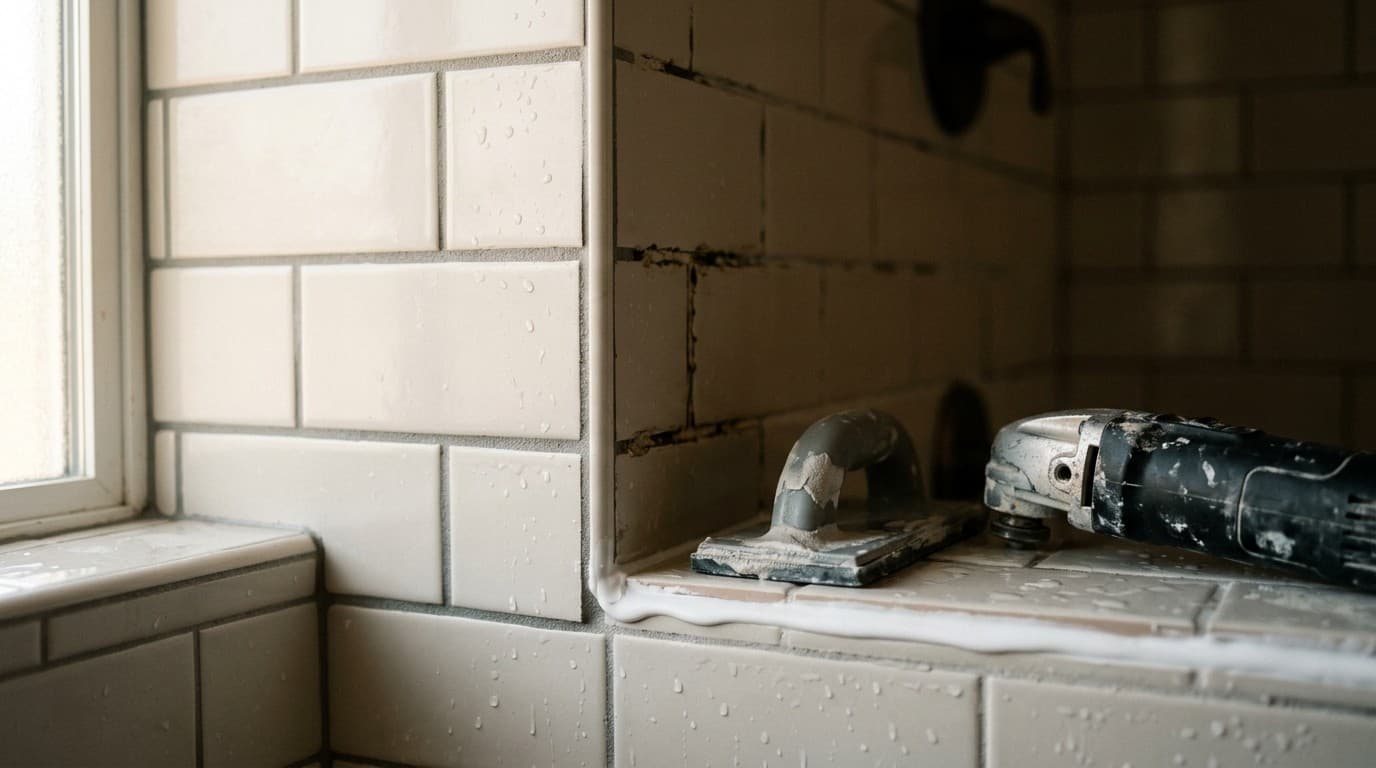
Short answer: you cannot regrout a shower by troweling new grout over the old. New grout needs at least about 2mm (roughly 1/16 inch) of clean depth to bond mechanically, and a skim coat over existing grout is often under 1mm, so it pops out within a season. A real regrout means removing grout to that depth first, and it only lasts if the tile and the shower behind it are still sound. Updated August 2026.
This is one of the most common questions we get from homeowners in Monmouth and Ocean County, usually phrased as some version of "can't you just grout over what's there?" The honest answer is no, and understanding why saves people from either a wasted Saturday or a contractor who agrees to do it and leaves them worse off. Jesse has been setting and repairing tile across the Jersey Shore for over 30 years, and JL Tile & Stone has been called in to fix more failed regrout-over-grout jobs than we can count. Here is what actually has to happen, and when a regrout is the right call versus when the grout is telling you about a bigger problem.
Why Does Grout Over Grout Fail Every Time?
Grout over grout fails because grout bonds mechanically, not chemically, and a thin skim has nothing to grip. Cementitious grout holds by filling the joint and locking into the depth and the textured sides of the space between tiles. When you spread fresh grout across the face of old grout, you are leaving a wafer-thin layer sitting on a smooth, sealed, often waxy surface with no depth to key into. It looks fine for a few weeks, then it cracks along the joints, powders, and lifts out in flakes the first time the shower flexes and the surface gets wet and dry a few dozen times.
The number that matters: new grout needs roughly 2mm of clean joint depth to develop a real bond, and 3mm is better on a wider joint. A skim coat over existing grout is frequently under 1mm. That is the entire difference between a regrout that lasts years and one that fails before the next season, and it is why "just grout over it" is never the job.
How Much Grout Has to Come Out Before New Grout Has Anything to Hold?
Enough grout has to come out that the new grout has at least 2mm of clean depth and two textured tile edges to bond to, which in practice means removing the top layer along the entire run being regrouted, not just the spots that look bad. Grouting only the visibly cracked joints leaves a patchwork of different ages and colors, and the old joints next to the new ones are usually the next to fail. If a wall is being regrouted, the whole wall comes down to depth.
What removal does not mean is gouging all the way to the substrate. The goal is a clean, uniform channel, not an excavation. Take too little and the new grout has no bond; take too much or wander off the joint and you chip the tile edges, which is the failure that turns a regrout into a re-tile. The depth is the target, and the discipline is staying inside the joint the whole way.
What Tools Are Used, and What Does Each Do to the Tile Edge?
Grout is removed with one of three tools, and the difference between them is how much control you have over the tile edge:
- Oscillating multi-tool with a grout blade. Our default on most showers. It is fast, controllable, and stays in the joint, and the carbide blade cuts cementitious grout without much heat. The risk is a slip across a tile face, so it is a steady-hand tool, not a rushed one.
- Manual grout saw. A hand tool with a carbide grit blade, slow but almost impossible to damage tile with. We reach for it on delicate stone, on glass tile, and anywhere a power tool is too aggressive for the material.
- Rotary tool with a grout guide. Fast on long straight runs, but the guide is what keeps it off the tile. Without one it is the tool most likely to leave chatter marks on the glaze.
The tool choice follows the tile, not the other way around. On natural stone or glass, the wrong blade at the wrong speed does damage that no amount of new grout hides, which is one more reason a shower that "just needs regrouting" is worth having someone look at before a rotary tool comes out.
When Is Regrouting Genuinely the Right Call?
Regrouting is the right fix when the tile is sound, the substrate behind it is dry and solid, and the only problem is the grout itself: staining, minor surface cracking, or powdering from age or a failed original mix. In that case a full-depth regrout genuinely restores the shower and buys many more years, and it is a fraction of the cost of a rebuild.
Good candidates for a straightforward regrout:
- Grout that is discolored or stained but not cracked, on tile that rings solid when tapped.
- Hairline surface cracks in the grout on a floor or wall that does not move.
- An older shower with a grout that was under-mixed or never sealed and is now powdering, over a substrate that is still sound.
- Cosmetic grout-color change on a shower that is otherwise in good shape.
If you want the fix to last, pair the regrout with the right material for a wet area. Our comparison of epoxy vs cement grout in a shower and our guide to how to pick a grout type both cover what to put back in the joint once it is clean.
When Is the Grout a Symptom, and the Shower the Real Problem?
Grout that cracks back out weeks after a proper regrout is almost never a grout problem; it is movement or water telling you the shower behind the tile is failing. Grout is rigid. If the wall or floor flexes, if the substrate is water-damaged, or if a tile is drummy, no grout on earth stays in that joint, and regrouting it is treating the symptom.
The signals that the problem is deeper than the grout:
- Grout that recracks in the same spot after being properly redone. The joint is moving.
- Tiles that sound hollow when tapped, which means they have lost their bond to the substrate. We cover this in why tile sounds hollow.
- Soft or spongy spots underfoot on the shower floor, or give in a wall, meaning water has reached the substrate.
- Recurring cracked tiles, not just grout, which points at deflection or a failed setting bed. Our post on what causes shower tile to crack walks through why.
When any of these are present, a regrout is money spent to delay a rebuild by a season, and we say so rather than take the job. Whether it is a repair or a rebuild is exactly the call in tile repair vs replacement.
Caulk or Grout at the Change of Plane, and Why Yours Cracked
Every place two planes meet (wall-to-wall corners, wall-to-floor, and around the tub or pan) should be caulked with a flexible sealant, not grouted, and grout in those joints is the single most common reason a shower "keeps cracking." Two surfaces that meet at an angle move independently, even slightly, as the house settles and the materials expand and contract. Rigid grout in that gap cannot flex, so it cracks, every time, and then it wicks water into the corner.
Here is what belongs where:
| Joint | What belongs there | Why |
|---|---|---|
| Flat field between tiles on one plane | Grout | No movement across the plane; grout is meant for this |
| Inside vertical corner (wall to wall) | Flexible caulk | Two walls move independently; grout cracks |
| Wall to floor / wall to shower pan | Flexible caulk | Biggest movement point in the shower |
| Around the tub, curb, or bench edge | Flexible caulk | Different materials expanding at different rates |
If your shower cracked at the corners and the bottom, the original installer almost certainly grouted a joint that should have been caulked. A real regrout fixes that too: grout out of the change-of-plane joints, flexible sealant in.
What We Check Before Agreeing to Regrout Anything
Before we quote a regrout, we tap the tile, test the joints, and look for movement and water, because a regrout on a failing shower is a warranty problem waiting to happen. The walk-through takes a few minutes and it is the difference between a fix that lasts and a fix that fails.
- Tap every tile across the field and listen for the hollow, drummy sound that means a lost bond.
- Press the change-of-plane joints and the floor for any give or softness that says water is behind the tile.
- Check the existing joints for whether the grout was rigid where it should have been caulk.
- Look at the tile edges for existing chips that removal could worsen, especially on stone and glass.
- Confirm the joint depth we can achieve without hitting the tile edges or the substrate.
If it passes, a regrout is one of the best-value repairs in a bathroom. If it does not, we tell you what the shower actually needs instead of taking a job that will call us back in six months.
Frequently Asked Questions
- Can you regrout a shower without removing the old grout?
No. New grout bonds mechanically and needs at least about 2mm of clean joint depth and two textured tile edges to hold. A skim of new grout over old grout is often under 1mm, sits on a smooth sealed surface, and cracks and lifts out within a season. A real regrout removes the top layer of old grout to depth first, then packs new grout into the clean joint.
- How much does it cost to regrout a shower in New Jersey?
It varies with the size of the shower, the tile material, and whether the change-of-plane joints need to be redone in caulk, so we quote it after a quick look rather than over the phone. What we can tell you is that a straightforward regrout on a sound shower is a fraction of the cost of a rebuild, which is exactly why it is worth confirming the shower is sound before spending the money on grout that will not hold otherwise.
- How long does a regrouted shower last?
A full-depth regrout on a sound shower, with flexible caulk in the corners and the right grout for a wet area, lasts many years, comparable to the original if it is sealed and maintained. A skim regrout over old grout lasts a season. A regrout on a shower that is actually moving or letting water into the substrate lasts until the next crack, which is why the condition of the shower matters more than the grout job itself.
- Why does my shower grout keep cracking in the same spot?
Because that joint is moving, and grout cannot flex. If it is a corner or the wall-to-floor line, it should be flexible caulk, not grout, and grout there will always recrack. If it is a flat run in the field that recracks, the substrate behind it is deflecting or a tile has lost its bond, and the fix is behind the tile, not in the joint.
- Should the corners of a shower be grouted or caulked?
Caulked, with a flexible sealant made for wet areas. Every change of plane (the inside vertical corners, the wall-to-floor joint, and anywhere tile meets the tub, pan, curb, or a bench) moves independently and needs a joint that can flex. Grout in those spots is rigid, cracks, and then wicks water into the corner, which is the most common install mistake we find.
- Do you regrout showers in my area?
Yes. JL Tile & Stone handles tile repair and regrouting across Monmouth and Ocean County, and we will tell you honestly whether your shower needs a regrout or something more before we quote it. Send a few photos or book a look through our contact page, and see the full range of what we do on our services page.