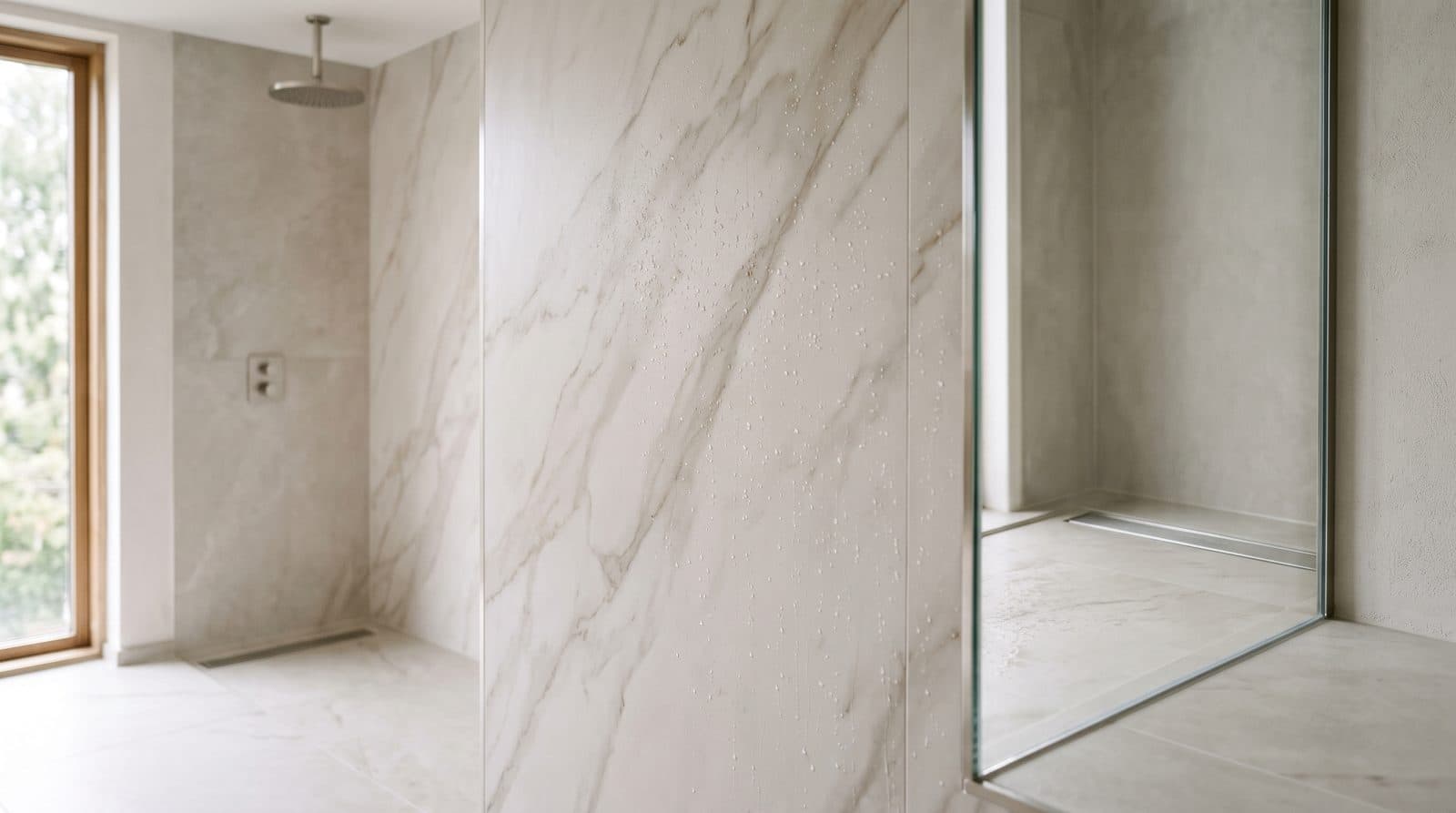
The lowest maintenance shower wall comes down to three decisions that weigh more than the tile you pick: how many grout joints you put in, what those joints are filled with, and where the water is allowed to sit when you turn the tap off. Get those three right and a tile shower asks almost nothing of you. Get them wrong and the prettiest tile in Monmouth County becomes a Saturday job every few months.
Updated November 2026.
People come to us having already decided the question is tile against acrylic, and that is the wrong first question. We have written that comparison up in tile shower vs acrylic surround. This post is about the thing that actually determines your weekends.
Grout lines are the maintenance, not the tile
Glazed porcelain and ceramic are effectively non-porous. Water does not get into them, soap does not stain them, and nothing you do in a normal shower wears the glaze off. The tile face is almost never what people are complaining about when they say their shower is hard to keep clean.
The joints are. So the honest way to compare two tile walls is to count the linear feet of joint in each. A wall in 4 by 4 inch tile has roughly four times the joint length of the same wall in 12 by 24 inch tile. Across the field of the wall that is about 6 linear feet of joint in every square foot against about 1.5, and a large format panel wall can cut it further again. Same cleaner, same shower habits, four times the surface that can hold a film. That is why large format keeps coming up in this conversation, and we cover the install side of it in large format tile installation.
There is a limit to the logic. A huge panel on a wall that is not flat enough will lip at the edges, and a lipped edge collects more than a tight small joint ever would. Fewer joints only helps when the substrate can carry it.
What goes in the joint matters more than how many there are
This is the part most people have never been offered a choice about. Cement grout is porous. It takes a sealer, the sealer wears, and at the Shore cement grout in a shower wants resealing on roughly a yearly cycle to keep doing its job. That is the maintenance schedule you are signing up for, and it is a real one.
Epoxy grout is not porous and does not want a sealer at all. It is harder to install, it costs more, it comes in fewer colours, and it punishes a slow installer. We steer nearly every shower client to it anyway, and on a shower floor or a wet wall in a seasonal coastal home we push harder than that. If you want the lowest maintenance shower wall available, this single decision moves the needle further than the tile selection does. The sealing side of cement grout is in when new grout can actually be sealed.
Where the water sits when you are done
The third factor is drainage and it is invisible in a showroom. Water that drains away leaves nothing behind. Water that stands anywhere leaves everything behind: minerals, soap film, and over time the dark line in the joint that no cleaner fixes because the problem is not dirt.
On a shore bathroom that means a correctly pitched floor, a bench with a slope on it rather than a flat shelf, a niche with a tilted sill, and a curb that sheds back into the shower. A flat niche sill is the single most common place we find a maintenance complaint that has nothing to do with the tile. The homeowner blames the grout. The sill is holding a teaspoon of water after every shower.
So what would we actually build
If upkeep is the brief and the budget allows, large format glazed porcelain, epoxy grout, a properly pitched floor and every horizontal surface given a fall. That shower gets a weekly wipe and nothing else. No annual reseal, no sealer shopping, no scrubbing a grid of joints.
An acrylic surround genuinely does beat it on joints, because it has almost none. What it loses on is the rest of the life: it marks, it dulls, it cannot be repaired in place, and when it goes it goes entirely rather than one joint at a time. Plenty of people take that trade knowingly and we will install it. Just take it knowingly.
And if you already have a cement-grouted shower, none of this means tearing it out. It means knowing which year you are in. We put the ongoing routine in how to maintain a tile shower, and what a tile shower should last in how long a tile shower lasts. Send us photographs of what you have and we will tell you which of the three factors is costing you the time.